In Simple Words
Imagine a bouncer standing outside a venue who checks guest tickets before letting anyone enter the building. Instead of the host personally reading hundreds of RSVPs, the bouncer pre-checks qualifications and restricts entry so the host only meets a small handpicked group of qualified guests.
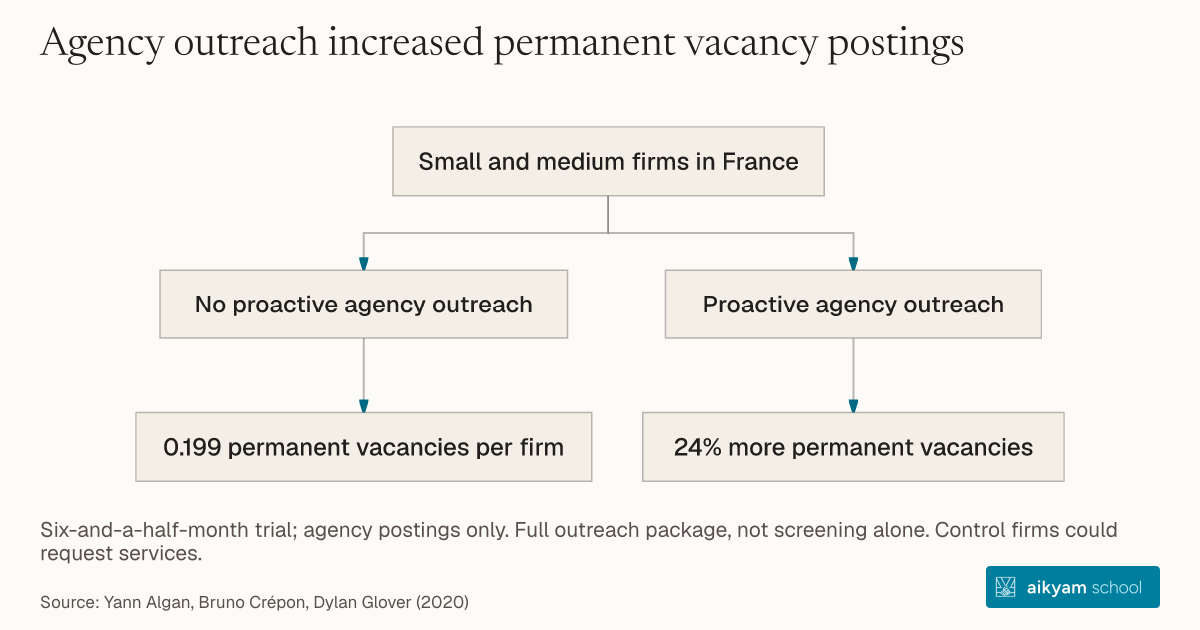
Small and medium firms in France
- No proactive agency outreach
- 0.199 permanent vacancies per firm
- Proactive agency outreach
- 24% more permanent vacancies
Six-and-a-half-month trial; agency postings only. Full outreach package, not screening alone. Control firms could request services.
See source →Research question
Employers opening job positions often incur high recruitment costs filtering out unsuited candidates from large applicant pools, especially in slack labor markets.
Participants
N = 7,438 unique small and medium-sized establishments across 129 local public employment agencies in France.
Study Design
Stratified Randomized Controlled Trial with a 3-month intensive prospection campaign and a sanctuary control group.
Results
Treatment increased permanent vacancy creation by 24% (0.047 vacancies per firm, p < 0.01) and pre-screening service usage by 58% (3.4 percentage point increase, p < 0.01), while reducing organic jobseeker applications received directly by firms by 39% (2.67 fewer applications, p < 0.01).
Takeaway
Delegate candidate initial verification and pre-selection screening to intermediary agency caseworkers to restrict applicant volume and lower private firm evaluation effort.
Source and citation
See source →Read alongside the research
Plain-English glossary
Original explanations, informed by the references below. Examples are illustrations, not data from the studies above. The research text stays unchanged.
- Percentage points
The difference between two percentages.
ExampleA rise from 40% to 50% is 10 percentage points. Relative to the starting value, that is a 25% increase.
Office for National Statistics · Percentages ↗Read more about percentage points →- Randomized controlled trial
A study that uses chance, like drawing lots, to decide who receives each option being compared. Researchers compare the groups’ outcomes to estimate the effect of those options.
ExampleA lottery assigns volunteers to a training programme or a comparison group. Researchers then compare their outcomes.
GET-IT glossary · Randomized study ↗Read more about randomized controlled trial →