In Simple Words
Imagine a student hiring a private tutor who is very friendly and supportive. Even if the student's test scores do not improve at all, the student rates the tutor highly and says they would pay to keep meeting them out of personal affection or the hope that the tutor might give them free study materials later. In microenterprises, business owners report high satisfaction and willingness to pay for elite consultants due to personal rapport or expectations of future cash grants, even when the advice fails to increase firm profits.
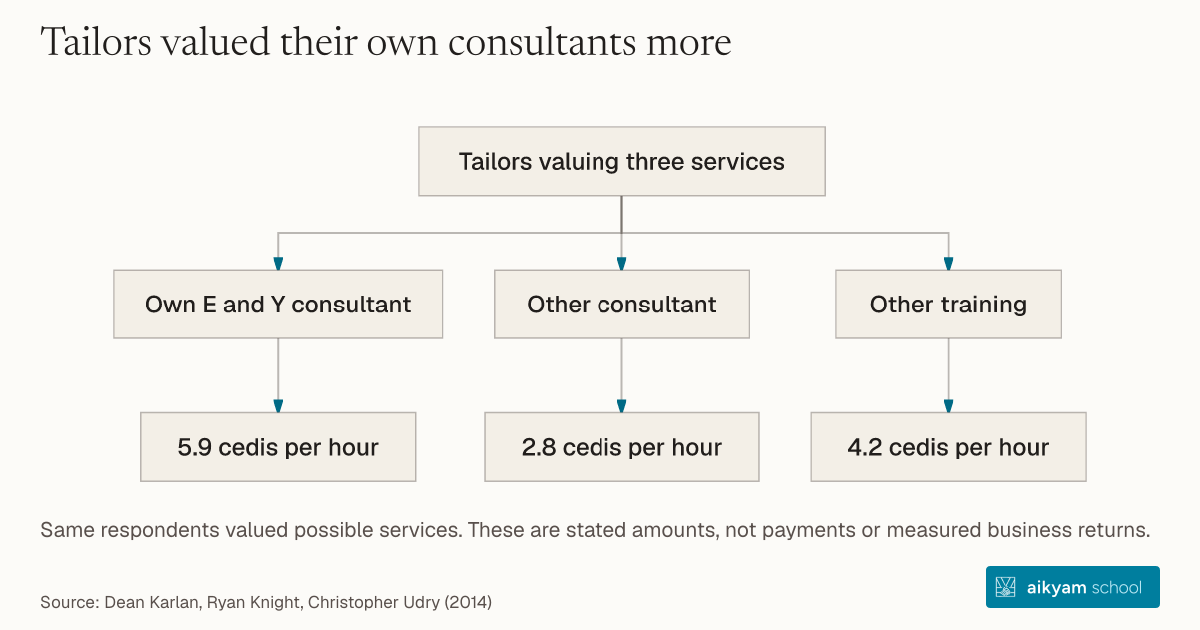
Tailors valuing three services
- Own E and Y consultant
- 5.9 cedis per hour
- Other consultant
- 2.8 cedis per hour
- Other training
- 4.2 cedis per hour
Same respondents valued possible services. These are stated amounts, not payments or measured business returns.
See source →Research question
Evaluators often rely on client satisfaction and stated willingness to pay to gauge the value of business advisory services, assuming subjective valuation reflects objective financial returns.
Participants
160 urban microenterprise tailors in Accra, Ghana.
Study Design
Randomized controlled trial measuring post-consulting willingness to pay (WTP) per hour across different advisor types (Ernst & Young consultants vs. generic trainers) compared against objective financial profits.
Results
Tailors reported a willingness to pay of 5.9 cedis (US $4) per hour to continue with Ernst & Young consultants, significantly higher than 2.8 cedis per hour for other consultants (p < 0.01) and 4.2 cedis per hour for alternate training (p < 0.05), despite consulting producing zero average income gains (0.905 cedi increase, p > 0.10) and an initial 26 cedi profit drop in Round 3 (p < 0.05).
Takeaway
Separate program evaluations from client satisfaction metrics by relying strictly on audited objective performance indicators rather than stated willingness to pay.
Source and citation
See source →Read alongside the research
Plain-English glossary
Original explanations, informed by the references below. Examples are illustrations, not data from the studies above. The research text stays unchanged.
- Randomized controlled trial
A study that uses chance, like drawing lots, to decide who receives each option being compared. Researchers compare the groups’ outcomes to estimate the effect of those options.
ExampleA lottery assigns volunteers to a training programme or a comparison group. Researchers then compare their outcomes.
GET-IT glossary · Randomized study ↗Read more about randomized controlled trial →