In Simple Words
To test if store owners treat people differently based on heritage, researchers send out actor buyers from different ethnic backgrounds who follow the exact same script and purchase the exact same items. By comparing what happens to each buyer at the exact same stores, researchers can catch discrimination red-handed.
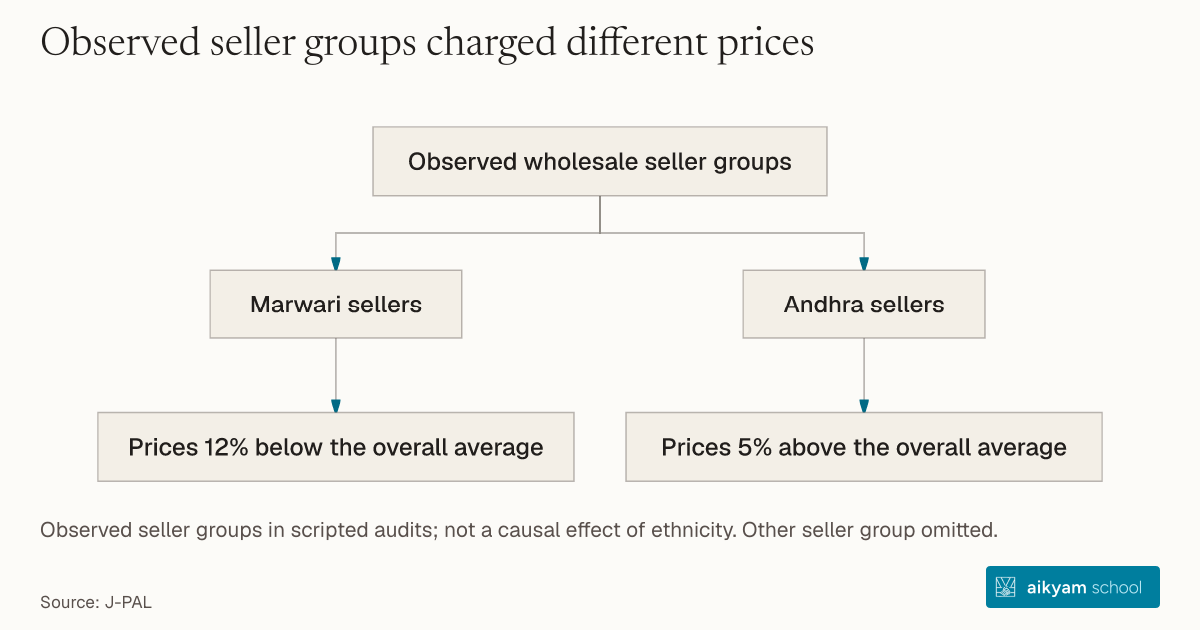
Observed wholesale seller groups
- Marwari sellers
- Prices 12% below the overall average
- Andhra sellers
- Prices 5% above the overall average
The study reports seller-group prices relative to the overall average. Seller ethnicity itself was not randomly assigned; the source does not explain the difference. Observed seller groups in scripted audits; not a causal effect of ethnicity. Other seller group omitted.
See source →Research question
Observational transaction data cannot isolate whether price differences stem from true credit risk differences, bargaining skill, or pure identity discrimination. Unbiased detection of ethnic market distortion requires controlled audit experiments that systematically rotate buyer identities across sellers.
Participants
107 pen and stationery shops in Chennai, India, visited by local entrepreneur auditors representing Tamil, Marwari, and Andhra groups.
Study Design
Randomized audit matching where each shop was visited at least once by auditors from each of the three communities using standardized negotiation scripts.
Results
Standardized multi-community audit visits successfully isolated seller pricing differences (-12% for Marwari sellers vs. +5% for Andhra sellers) and buyer-seller match effects independently of product quality or negotiation script variations.
Takeaway
Deploy matched-pair audit buyer teams adhering to identical negotiation protocols to measure discrimination across supply chain vendors.