In Simple Words
Think of a driver's license from a foreign country. Even if a driver has navigated roads for years abroad, local testing officials do not know the traffic rules or driving culture of that driver's hometown, so they treat the driver as a beginner and require local road test experience before trusting their skills.
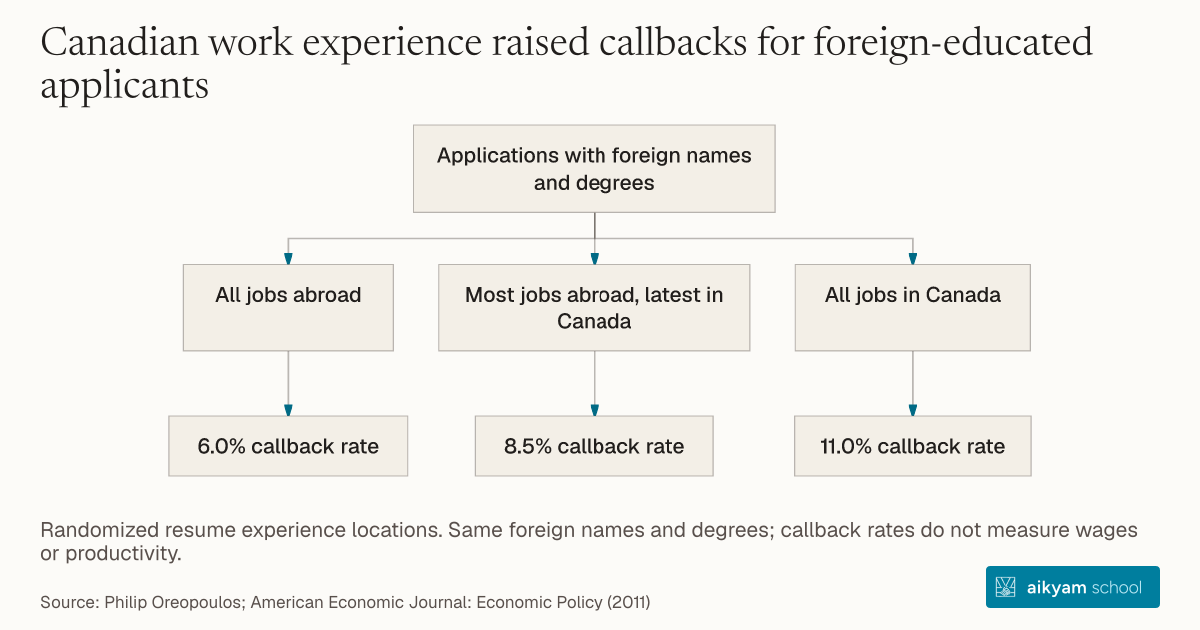
Applications with foreign names and degrees
- All jobs abroad
- 6.0% callback rate
- Most jobs abroad, latest in Canada
- 8.5% callback rate
- All jobs in Canada
- 11.0% callback rate
Randomized resume experience locations. Same foreign names and degrees; callback rates do not measure wages or productivity.
See source →Research question
Skilled immigrants arriving under point-based immigration systems experience persistent labor market disadvantages because host-country employers heavily discount job experience acquired in foreign countries compared to host-country experience.
Participants
N = 12,910 resumes submitted to 3,225 job postings across 20 occupations in Toronto and Montreal, Canada (human job applicants aged 25-39).
Study Design
Randomized field experiment / resume audit study submitting four mock resumes per employer, systematically varying foreign versus domestic work experience while holding job descriptions identical.
Results
Resumes with foreign qualifications and foreign experience received a 6.0% callback rate compared to 15.7% for native Canadian resumes. Adding one domestic Canadian job increased callback rates from 6.0% to 8.5%, while replacing all foreign experience with Canadian experience raised callback rates to 11.0% (p < 0.01).
Takeaway
Establish standardized global work experience equivalency frameworks and subsidized bridge internships to help skilled immigrants obtain initial host-country work experience.