In Simple Words
Imagine spreading out a heavy load across all four wheels of a wagon instead of piling everything onto the back tailgate right before driving uphill. By establishing explicit weekly milestone targets early in the cycle, workers distribute a heavy workload smoothly over time rather than suffering an end-of-month crunch.
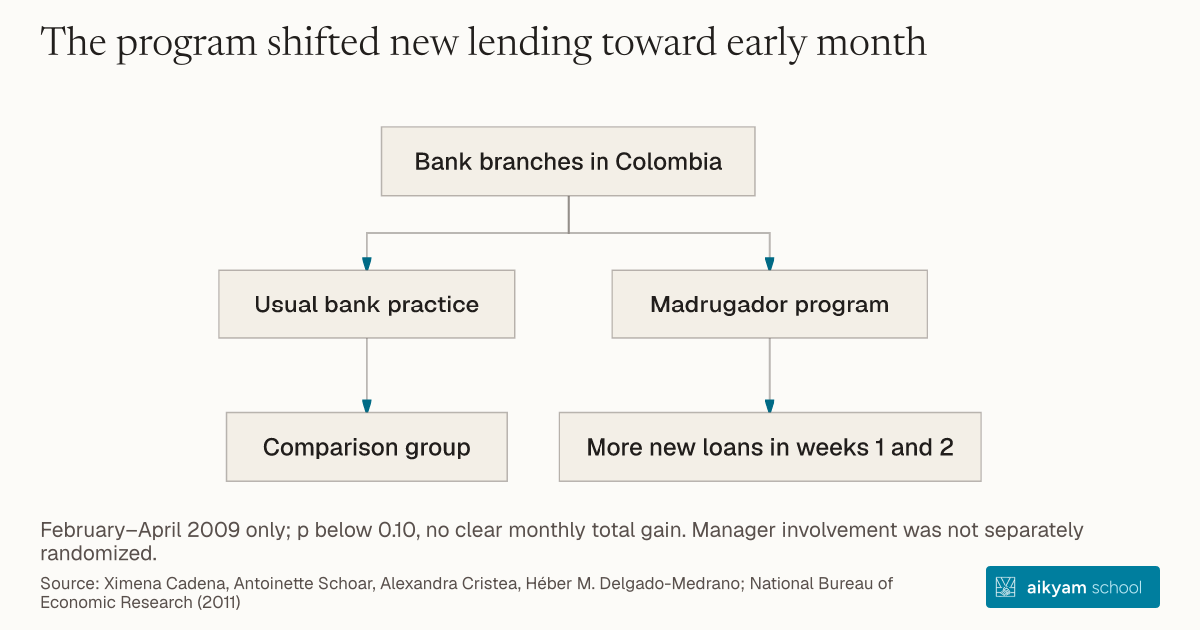
Bank branches in Colombia
- Usual bank practice
- Comparison group
- Madrugador program
- More new loans in weeks 1 and 2
February–April 2009, after managers joined the program. New-loan sourcing shifted to weeks 1 and 2, p below 0.10; no clear monthly total gain. Manager involvement was not separately randomized.
See source →Research question
Employees facing monthly evaluation cycles routinely postpone effort-intensive tasks to the final weeks of the period. This concentration of effort creates severe operational bottlenecks, high employee burnout, cash flow mismatches, and rushed decision-making.
Participants
N = 61 bank branches (31 treatment, 30 control) and 388 loan officers (average portfolio of 500 loans and ~35 new loans monthly) in Colombia.
Study Design
Difference-in-differences analysis within a randomized controlled trial comparing pre-treatment baseline (July–October 2008) to post-treatment period (November 2008–April 2009).
Results
Treatment branches experienced an 18% increase in new loan sourcing and a 10% increase in loan renewals during the first two weeks of the month (~1 additional loan per branch in weeks 1–2, p < 0.10) and a 12% reduction in distance from ideal monthly task distribution (gap indicator decreased by 6.6 to 9.8 points, p < 0.05) without increasing delinquency rates.
Takeaway
Deconstruct monthly performance quotas into explicit weekly targets that frontload 60% of total target completions into the first two weeks of the production cycle.
Source and citation
See source →Read alongside the research
Plain-English glossary
Original explanations, informed by the references below. Examples are illustrations, not data from the studies above. The research text stays unchanged.
- Baseline
The starting measurements in a study. Researchers use these to compare what participants were like at the start with what happens later.
ExampleBefore a training programme starts, researchers measure workers’ earnings. That first measurement is the baseline.
GET-IT glossary · Baseline characteristics ↗Read more about baseline →- Randomized controlled trial
A study that uses chance, like drawing lots, to decide who receives each option being compared. Researchers compare the groups’ outcomes to estimate the effect of those options.
ExampleA lottery assigns volunteers to a training programme or a comparison group. Researchers then compare their outcomes.
GET-IT glossary · Randomized study ↗Read more about randomized controlled trial →