Try, learn and adjust
Check progress during target weeks
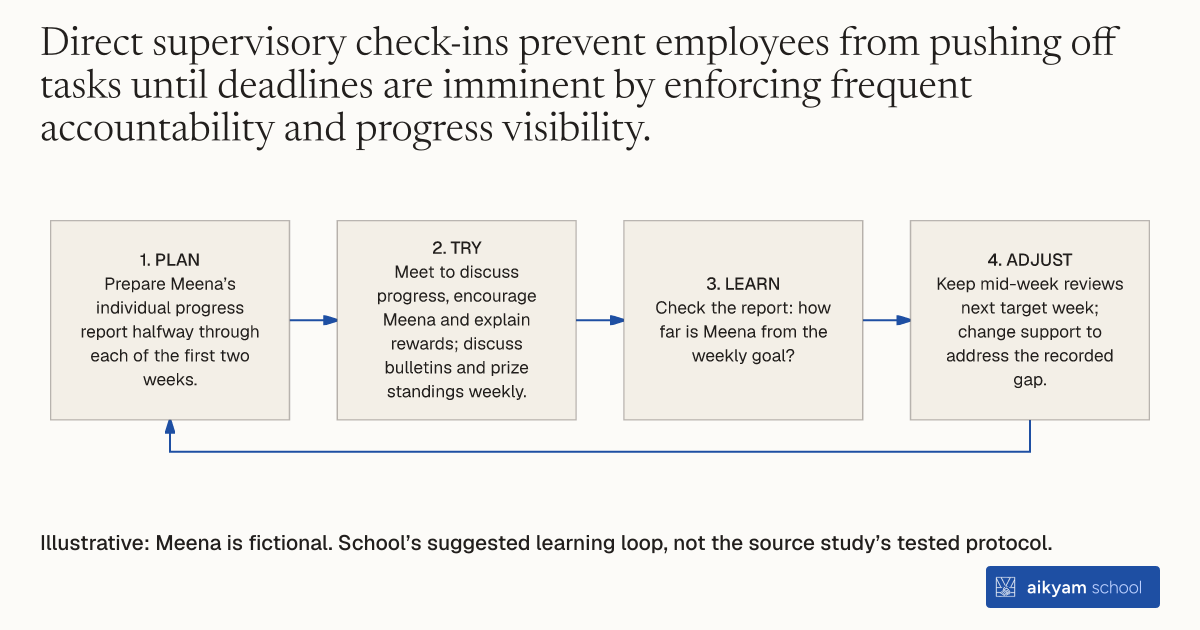
- Plan: Prepare Meena’s individual progress report halfway through each of the first two weeks.
- Try: Meet to discuss progress, encourage Meena and explain rewards; discuss bulletins and prize standings weekly.
- Learn: Check the report: how far is Meena from the weekly goal?
- Adjust: Keep mid-week reviews next target week; change support to address the recorded gap.
Illustrative: Meena is fictional. School’s suggested learning loop, not the source study’s tested protocol.
See source →School’s suggested, untested loop. Observe mid-week reports, progress against goals and reminders; no productivity gain is assumed.
How
When to use
Frontline staff given performance targets often lack mid-cycle operational check-ins, allowing early deadlines to slip. Supervisory progress tracking and mid-week updates bring temporal goals back into focus and provide ongoing encouragement. This method helps branch managers actively guide procrastinating employees toward structured, early-period task completion.
Engage direct supervisors to review weekly performance reports and conduct mid-week progress check-ins with frontline employees.
- Program administrators generate mid-week tracking reports showing individual officer progress halfway through each target week.
- Branch managers meet with loan officers halfway through the first and second weeks to discuss placement status and weekly targets.
- Managers review performance reports with officers, showing how close each person is to achieving weekly goals.
- Managers provide verbal encouragement and remind officers of available program rewards for meeting targets.
- Managers conduct weekly discussions with officers regarding monthly bulletins and grand prize standings to maintain focus throughout the month.
Why it works
Active encouragement from managers validates short-term targets and helps workers overcome planning fallacies during the work cycle.
Example
In Colombia, Bancamía branch managers in 31 treatment branches conducted mid-week progress meetings and shared individual tracking reports with loan officers during the second phase of the Madrugador Program. This active supervisory reinforcement drove loan officer weekly goal achievement up by 70 percentage points compared to control branches.
About the study
Participants
61 bank branches (31 treatment, 30 control) and 388 loan officers in Colombia.
Study Design
Randomized controlled trial comparing Phase 1 (loan officer incentives only, Nov 2008 to Jan 2009) to Phase 2 (manager incentives and active reminders added, Feb to Apr 2009) using OLS regressions with branch and month fixed effects and clustered standard errors.
Results
Target achievement increased by 70.0 percentage points (p < 0.05) and the workload gap index dropped by 9.58 to 9.84 points (p < 0.01) during Phase 2 when branch managers provided mid-week check-ins and progress reports, whereas Phase 1 showed no statistically significant effect.