In Simple Words
Imagine choosing between starting a risky street-food cart or taking an entry-level office job with a guaranteed monthly salary—despite the freedom of running a cart, most young workers prefer the office job because predictable income shields them from severe financial shocks.
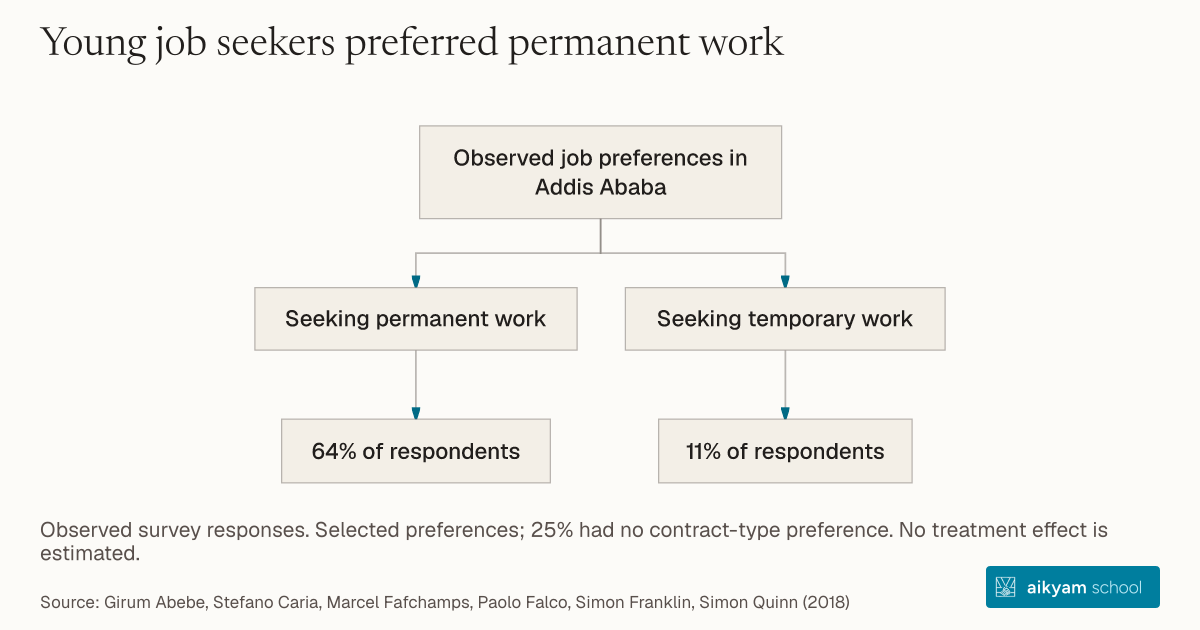
Observed job preferences in Addis Ababa
- Seeking permanent work
- 64% of respondents
- Seeking temporary work
- 11% of respondents
Observed survey responses. Selected preferences; 25% had no contract-type preference. No treatment effect is estimated.
See source →Research question
Active labor market programs frequently promote self-employment or gig work under the assumption that youth prefer entrepreneurial independence, ignoring strong baseline preferences for stable wage employment.
Participants
N = 3,052 youth job-seekers (aged 18–29, high school educated) in Addis Ababa, Ethiopia.
Study Design
Baseline survey elicitation of preferred search contract types, job quality rankings, and reasons for non-search.
Results
64% of youth searched specifically for permanent jobs (versus 11% seeking temporary work), work stability was the second most cited desirable job characteristic (20.4% versus 6.7% for working hours), and only 5.4% cited starting a business as a reason for non-search.
Takeaway
Prioritize formal wage-employment matching programs over self-employment subsidies when designing active labor market policies for urban youth.
Source and citation
See source →Read alongside the research
Plain-English glossary
Original explanations, informed by the references below. Examples are illustrations, not data from the studies above. The research text stays unchanged.
- Baseline
The starting measurements in a study. Researchers use these to compare what participants were like at the start with what happens later.
ExampleBefore a training programme starts, researchers measure workers’ earnings. That first measurement is the baseline.
GET-IT glossary · Baseline characteristics ↗Read more about baseline →