In Simple Words
Imagine a chef running a single small diner who personally checks every dish before it leaves the kitchen. If the chef opens a second diner across town without written recipes or trained head cooks, food quality plummets because the chef cannot be in two places at once. Standardizing recipes and training line managers allows the chef to open multiple successful diner locations while maintaining quality from a distance.
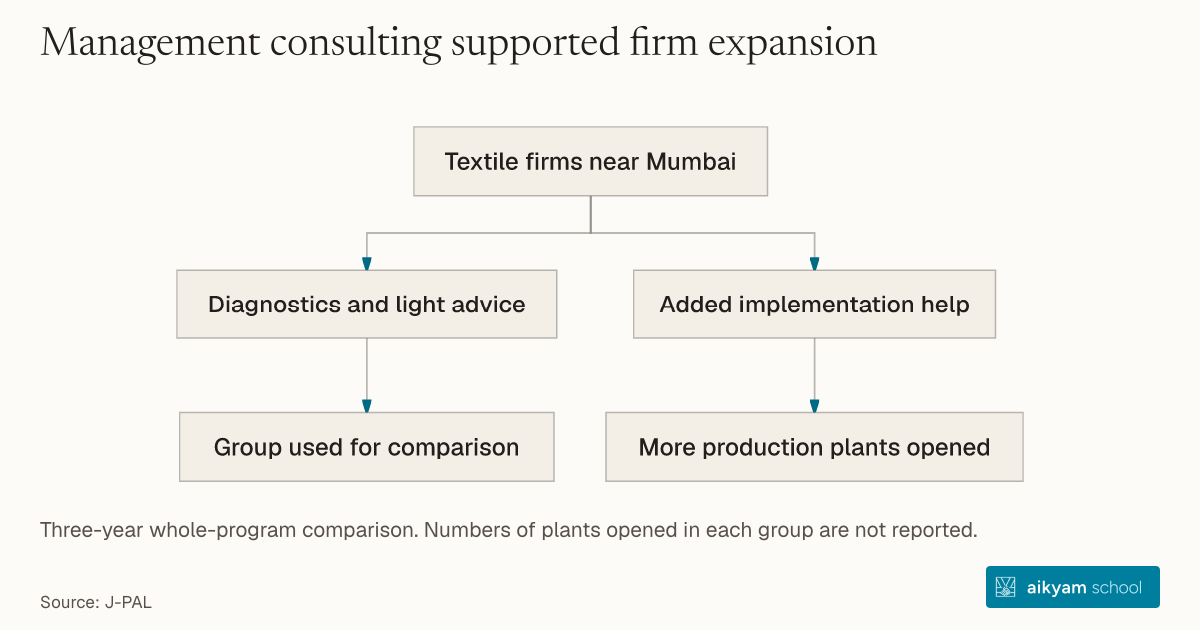
Textile firms near Mumbai
- Diagnostics and light advice
- Group used for comparison
- Added implementation help
- More production plants opened
Firms assigned implementation consulting opened more production plants than comparison firms in the three years after the experiment began. Three-year whole-program comparison. Numbers of plants opened in each group are not reported. Both groups received diagnostics and light follow-up advice; treatment plants received added implementation help.
See source →Research question
Poor management limits the effective span of executive control, preventing manufacturing firms from opening new factories without suffering severe operational breakdowns.
Participants
N = 17 large manufacturing textile firms (comprising 28 factory plants) located in Mumbai, India, averaging 270 human employees, US$13 million in assets, and US$7.5 million in annual sales per firm.
Study Design
Randomized Controlled Trial (RCT) evaluating a 3-phase consulting intervention and tracking multi-plant expansion over a 3-year follow-up period.
Results
Treatment firms that adopted modern management practices successfully opened more production plants in the three years following the start of the experiment than comparison firms.
Takeaway
Implement standardized operational reporting protocols across core facilities to establish managerial delegation capacity prior to launching new production sites.
Source and citation
See source →Read alongside the research
Plain-English glossary
Original explanations, informed by the references below. Examples are illustrations, not data from the studies above. The research text stays unchanged.
- Follow-up
Collecting more information about participants later in a study to see what has happened to them. The term can also mean the length of time researchers keep track of them.
ExampleResearchers interview the same workers three months after a programme ends. That later interview is a follow-up.
GET-IT glossary · Follow-up ↗Read more about follow-up →- Randomized controlled trial
A study that uses chance, like drawing lots, to decide who receives each option being compared. Researchers compare the groups’ outcomes to estimate the effect of those options.
ExampleA lottery assigns volunteers to a training programme or a comparison group. Researchers then compare their outcomes.
GET-IT glossary · Randomized study ↗Read more about randomized controlled trial →