In Simple Words
Imagine buying a high-tech dashboard that flashes red lights whenever a car engine overheats, but failing to hire a mechanic or buy tools to fix the engine. Merely collecting and staring at error logs does not prevent breakdowns; the dashboard only creates value when paired with a trained repair team and scheduled fix-it routines.
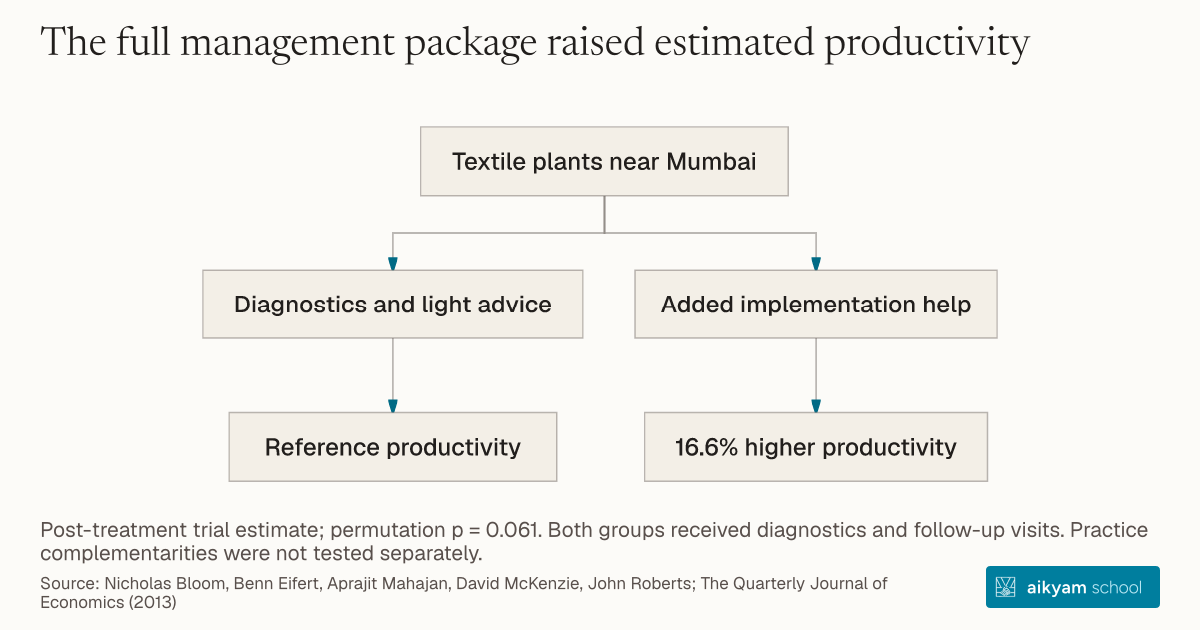
Textile plants near Mumbai
- Diagnostics and light advice
- Reference productivity
- Added implementation help
- 16.6% higher productivity
Post-treatment trial estimate; permutation p = 0.061. Both groups received diagnostics and follow-up visits. Practice complementarities were not tested separately.
See source →Research question
Adopting individual operational practices in isolation yields minimal performance improvements because management systems rely on complementary interactions between measurement, analysis, and action protocols.
Participants
28 manufacturing plants across 17 multiplant textile firms near Mumbai, India.
Study Design
Randomized Controlled Trial (RCT) comparing control plants receiving diagnostic defect recording against treatment plants adopting integrated review, defect analysis, and action planning routines.
Results
Control plants adopted data collection practices increasing practice scores by 12.0 percentage points, but achieved negligible productivity improvements compared to treatment plants, which implemented full complementary review systems and increased TFP by 16.6% (p = 0.061).
Takeaway
Pair all data tracking systems with daily review meetings and formal action plans to ensure collected operational metrics drive corrective interventions.
Source and citation
See source →Read alongside the research
Plain-English glossary
Original explanations, informed by the references below. Examples are illustrations, not data from the studies above. The research text stays unchanged.
- Percentage points
The difference between two percentages.
ExampleA rise from 40% to 50% is 10 percentage points. Relative to the starting value, that is a 25% increase.
Office for National Statistics · Percentages ↗Read more about percentage points →- Randomized controlled trial
A study that uses chance, like drawing lots, to decide who receives each option being compared. Researchers compare the groups’ outcomes to estimate the effect of those options.
ExampleA lottery assigns volunteers to a training programme or a comparison group. Researchers then compare their outcomes.
GET-IT glossary · Randomized study ↗Read more about randomized controlled trial →