In Simple Words
Think of learning how to ride a bicycle with a trainer holding the handlebars. Once a rider masters balance, steering, and braking routines, they continue riding smoothly on their own even after the trainer leaves because riding is faster, easier, and more useful than walking.
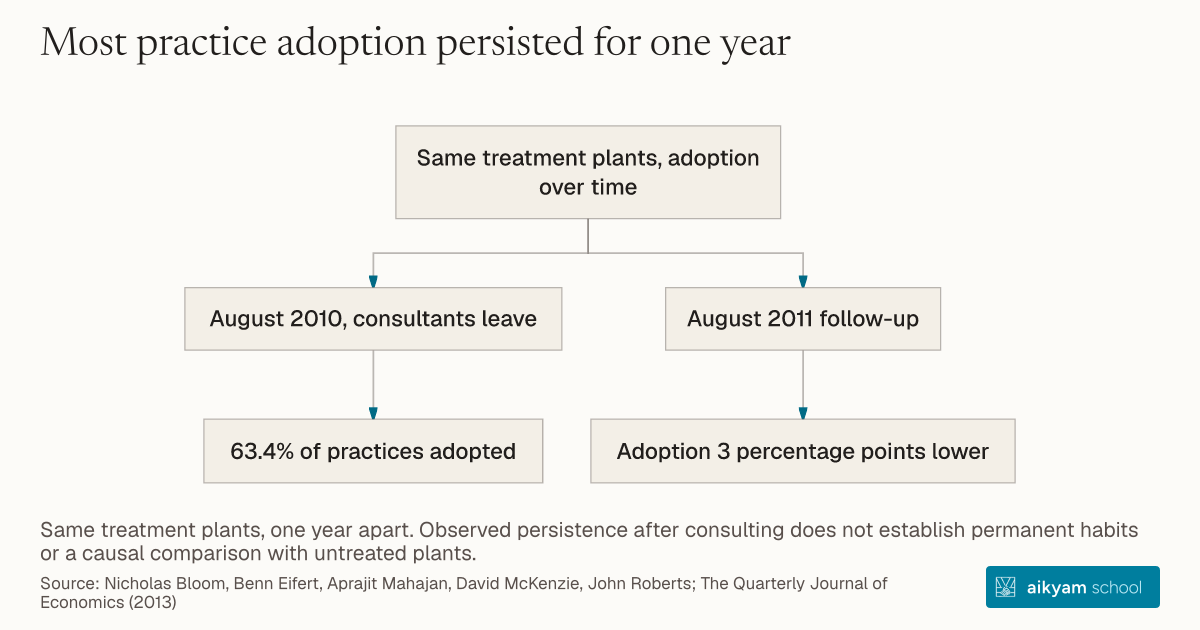
Same treatment plants, adoption over time
- August 2010, consultants leave
- 63.4% of practices adopted
- August 2011 follow-up
- Adoption 3 percentage points lower
Same treatment plants, one year apart. Observed persistence after consulting does not establish permanent habits or a causal comparison with untreated plants.
See source →Research question
Field interventions evaluating organizational improvements often suffer from operational backsliding or decay once active external consulting oversight concludes.
Participants
14 treatment plants across multiplant Indian textile firms monitored over a 12-month post-intervention follow-up window (August 2010 to August 2011).
Study Design
Unannounced 1-year follow-up survey measuring adoption across 38 management practices after active consulting ended in August 2010 without prior participant notification.
Results
Management practice adoption dropped by only 3 percentage points on average (from 63.4% to 60.4%) 12 months after consultants left, demonstrating that lean practice adoption creates permanent structural habit shifts.
Takeaway
Embed newly introduced operational standard operating procedures into daily supervisor routines and visual tracking templates to ensure long-term persistence without continuous external oversight.
Source and citation
See source →Read alongside the research
Plain-English glossary
Original explanations, informed by the references below. Examples are illustrations, not data from the studies above. The research text stays unchanged.
- Follow-up
Collecting more information about participants later in a study to see what has happened to them. The term can also mean the length of time researchers keep track of them.
ExampleResearchers interview the same workers three months after a programme ends. That later interview is a follow-up.
GET-IT glossary · Follow-up ↗Read more about follow-up →- Percentage points
The difference between two percentages.
ExampleA rise from 40% to 50% is 10 percentage points. Relative to the starting value, that is a 25% increase.
Office for National Statistics · Percentages ↗Read more about percentage points →