Try, learn and adjust
Check rules before paying the retailer bonus
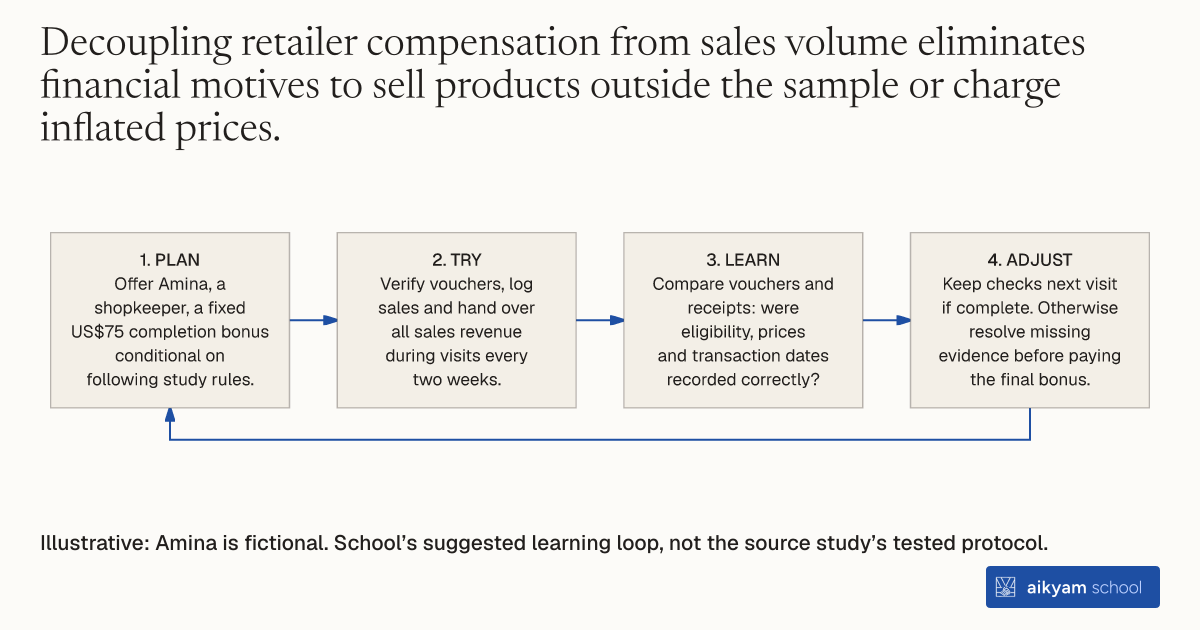
- Plan: Offer Amina, a shopkeeper, a fixed US$75 completion bonus conditional on following study rules.
- Try: Verify vouchers, log sales and hand over all sales revenue during visits every two weeks.
- Learn: Compare vouchers and receipts: were eligibility, prices and transaction dates recorded correctly?
- Adjust: Keep checks next visit if complete. Otherwise resolve missing evidence before paying the final bonus.
Illustrative: Amina is fictional. School’s suggested learning loop, not the source study’s tested protocol.
See source →School’s suggested, untested learning loop. Observe rule compliance and revenue handover; the bonus is independent of sales volume.
How
When to use
Programs distributing subsidized health products through local merchants face risks of price gouging, unauthorized sales, or inventory leakage if shopkeepers retain sales margins. Paying vendors a fixed lump-sum payment rather than sales commission aligns merchant incentives with strict project rules. This strategy prevents retailers from charging higher prices or reselling subsidized goods to non-eligible buyers.
Incentivize local retail partners to enforce subsidized distribution rules using fixed completion bonuses rather than sales margins.
- Prohibit participating retail shopkeepers from retaining cash proceeds generated from subsidized product redemptions.
- Require shopkeepers to collect all cash payments and hand over sales revenue to project staff during bi-weekly visits.
- Offer participating merchants a guaranteed lump-sum payment of 75 US dollars upon project completion.
- Condition bonus disbursement on full protocol compliance, including verifying customer vouchers, logging transaction dates, and preventing unauthorized sales.
- Collect voucher stubs and receipt logs every two weeks to verify adherence before paying the final bonus.
Why it works
A guaranteed completion bonus creates a strong incentive for shopkeepers to follow protocol rules and maintain accurate transaction logs.
Example
In Busia District, Kenya, researchers offered six local retail shopkeepers a fixed $75 bonus upon study completion for strictly following voucher redemption and logging rules without keeping net sales proceeds.
About the study
Participants
6 participating retail shopkeepers across six rural enumeration areas in Busia District, Western Kenya.
Study Design
Randomized field trial implementation where retailers managed voucher redemptions for 1,120 households while receiving a $75 lump-sum bonus contingent on protocol compliance.
Results
All interviewed households confirmed being charged exact assigned prices, and 95 percent of all redeemed vouchers were presented directly by target household members.