In Simple Words
Picture a small local auto repair shop being hired as the official maintenance provider for a multinational delivery company. To fulfill the large contract, the shop upgrades its diagnostic tools, hires specialized mechanics, and adopts modern inventory management, which then enables the shop to attract additional high-paying corporate clients across the country.
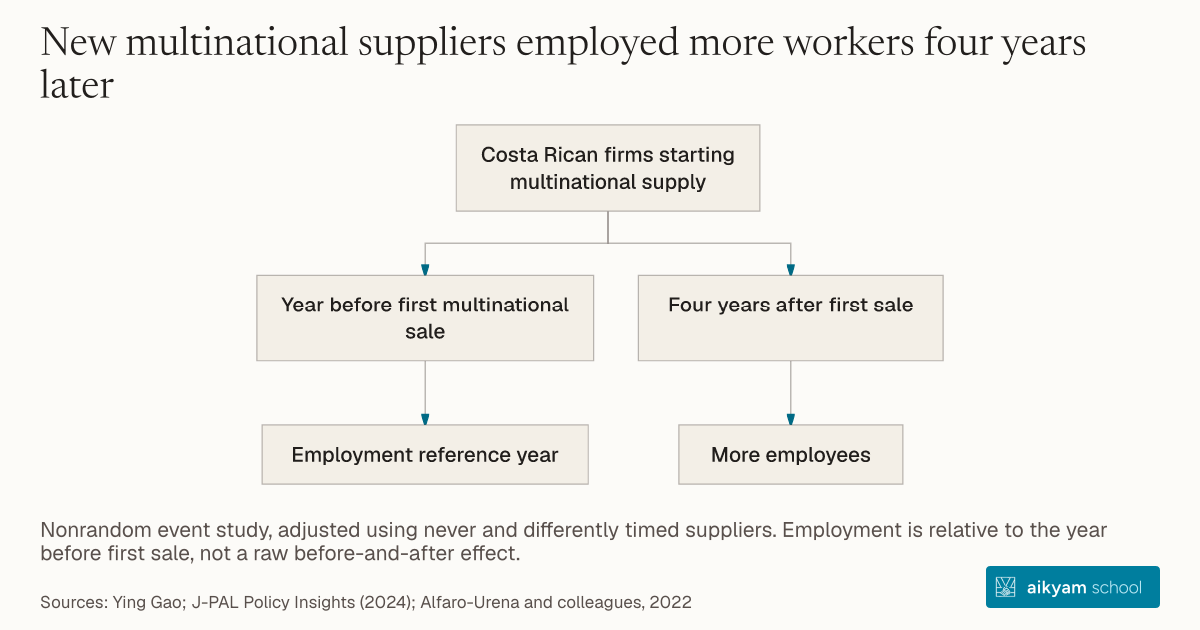
Costa Rican firms starting multinational supply
- Year before first multinational sale
- Employment reference year
- Four years after first sale
- More employees
Nonrandom event study, adjusted using never and differently timed suppliers. Employment is relative to the year before first sale, not a raw before-and-after effect.
See source →Study conditions — Alfaro-Urena and colleagues, 2022 ↗Research question
Small and medium enterprises in low- and middle-income countries struggle with low productivity, limited workforce growth, and restricted customer reach when operating in isolation. They lack linkages to large-volume corporate buyers that drive organizational scaling and operational spillovers.
Participants
Small and medium enterprises (SMEs) across various supplier sectors in Costa Rica.
Study Design
Quasi-experimental longitudinal study evaluating firm trajectories four years after supply chain integration.
Results
Four years after becoming suppliers to multinational corporations, SMEs were significantly more likely to employ more workers, expand sales to non-multinational buyers, and achieve higher total factor productivity.
Takeaway
Implement national match-making and procurement programs that connect small and medium enterprises directly as suppliers to multinational corporations operating within the host country.