Try, learn and adjust
Check delivery against multinational buyer standards
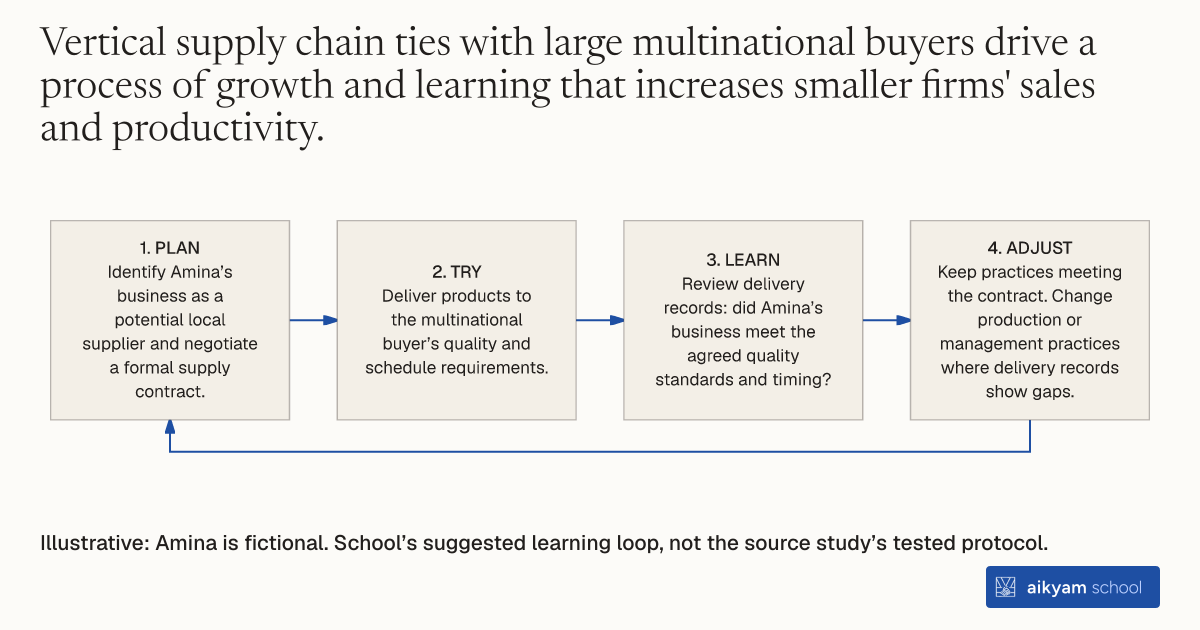
- Plan: Identify Amina’s business as a potential local supplier and negotiate a formal supply contract.
- Try: Deliver products to the multinational buyer’s quality and schedule requirements.
- Learn: Review delivery records: did Amina’s business meet the agreed quality standards and timing?
- Adjust: Keep practices meeting the contract. Change production or management practices where delivery records show gaps.
Illustrative: Amina is fictional. School’s suggested learning loop, not the source study’s tested protocol.
See source →School’s suggested, untested loop. Observe contract requirements and deliveries; no later employment or productivity gain is assumed.
How
When to use
Small and medium enterprises in lower-income countries often struggle to grow, hire workers, and raise productivity due to demand-side market constraints. Linking these small domestic firms directly to multinational corporations operating within the country provides steady demand and integration into global supply chains. This mechanism helps domestic suppliers expand sales to other buyers and improve overall efficiency over time.
Connect small domestic firms as suppliers to multinational corporations operating in the country.
- Governments and buyer-matching programs identify local small enterprises capable of supplying multinational corporations.
- Multinational corporations negotiate formal supply contracts with selected local firms to purchase goods or services.
- Local suppliers deliver products that meet foreign buyer quality and schedule standards.
- Suppliers use the steady corporate demand to expand production capacity and improve internal management practices.
- Local suppliers leverage their enhanced reputation and capabilities to sell to other buyers across the economy.
Why it works
Interacting with multinational corporate buyers transfers technical standards and provides stable demand that encourages operational expansion.
Example
In Costa Rica, small and medium enterprises became suppliers to multinational corporations, resulting in higher employment, expanded sales to non-multinational buyers, and increased productivity four years later.
About the study
Participants
Small and medium enterprises (SMEs) supplying goods and services in Costa Rica.
Study Design
Quasi-experimental study analyzing firm performance four years after joining multinational supply chains.
Results
Four years after starting to supply multinational corporations, SMEs employed more workers, sold more to other firms, and achieved higher productivity.