In Simple Words
Imagine buying an appliance with a 60-day test period. If you picked the appliance blindly from a bargain bin, it will likely break or be returned within two months. But if you picked an appliance that came with a certified inspection seal, it is far more likely to perform smoothly and stay on your kitchen counter long after the 60-day trial ends. Certified candidate vetting ensures new hires pass their probation trial and remain productive long-term team members.
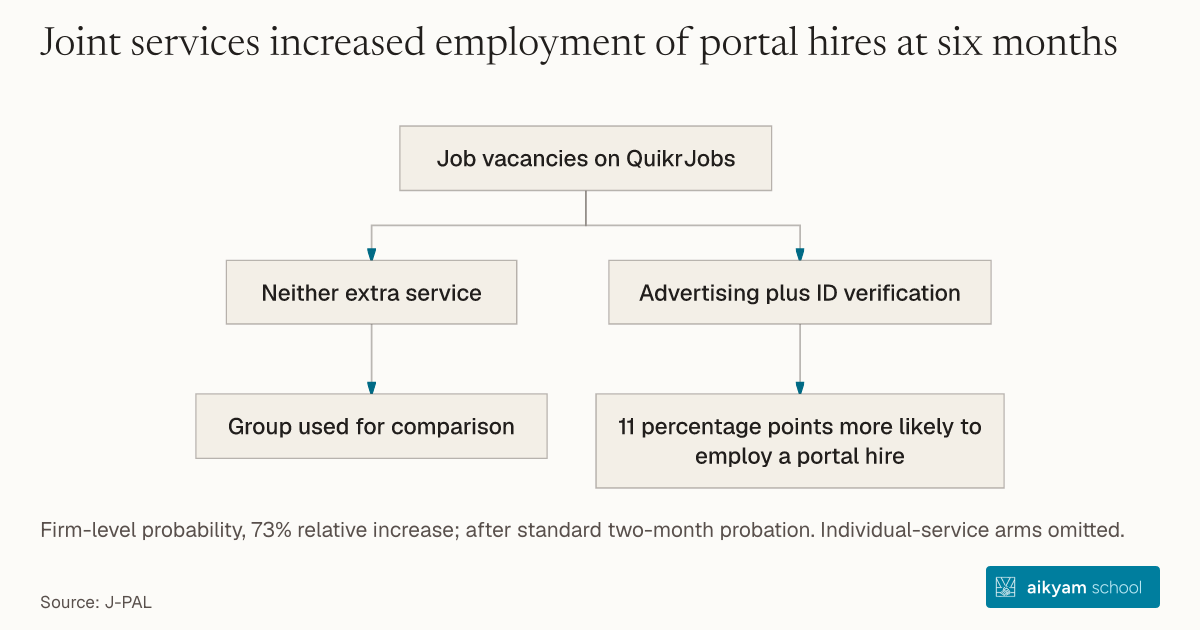
Job vacancies on QuikrJobs
- Neither extra service
- Group used for comparison
- Advertising plus ID verification
- 11 percentage points more likely to employ a portal hire
At six months firms assigned joint services were more likely to employ a worker hired through the portal. This is a firm-level outcome, not retention conditional on having hired. Firm-level probability, 73% relative increase; after standard two-month probation. Individual-service arms omitted.
See source →Research question
Screening unfamiliar hires often results in high short-term turnover during initial probation if digital recruitment mechanisms fail to establish true match quality and candidate integrity.
Participants
1,719 job vacancies across 1,576 firms in Bengaluru, India.
Study Design
Longitudinal follow-up survey conducted 6 months post-intervention, following a standard 2-month employee probation period.
Results
Firms receiving combined advertising and verification services were 11 percentage points (73 percent) more likely to still employ their online portal hire 6 months post-posting compared to comparison firms.
Takeaway
Evaluate digital hiring platform efficacy based on candidate retention metrics 6 months post-hire rather than initial application or interview rates.
Source and citation
See source →Read alongside the research
Plain-English glossary
Original explanations, informed by the references below. Examples are illustrations, not data from the studies above. The research text stays unchanged.
- Longitudinal study
A study that checks the same group of people at different times. This lets researchers examine how things change over time.
ExampleResearchers ask the same workers about their wellbeing at the start, after three months and after six months.
NICE · Longitudinal study ↗Read more about longitudinal study →- Follow-up
Collecting more information about participants later in a study to see what has happened to them. The term can also mean the length of time researchers keep track of them.
ExampleResearchers interview the same workers three months after a programme ends. That later interview is a follow-up.
GET-IT glossary · Follow-up ↗Read more about follow-up →- Percentage points
The difference between two percentages.
ExampleA rise from 40% to 50% is 10 percentage points. Relative to the starting value, that is a 25% increase.
Office for National Statistics · Percentages ↗Read more about percentage points →