In Simple Words
Think of a job agency that focuses on helping people find stable, long-term careers rather than quick temp jobs that end after a few weeks. By spending extra time finding the right fit, people stay employed in the same job for over six months instead of falling back into unemployment.
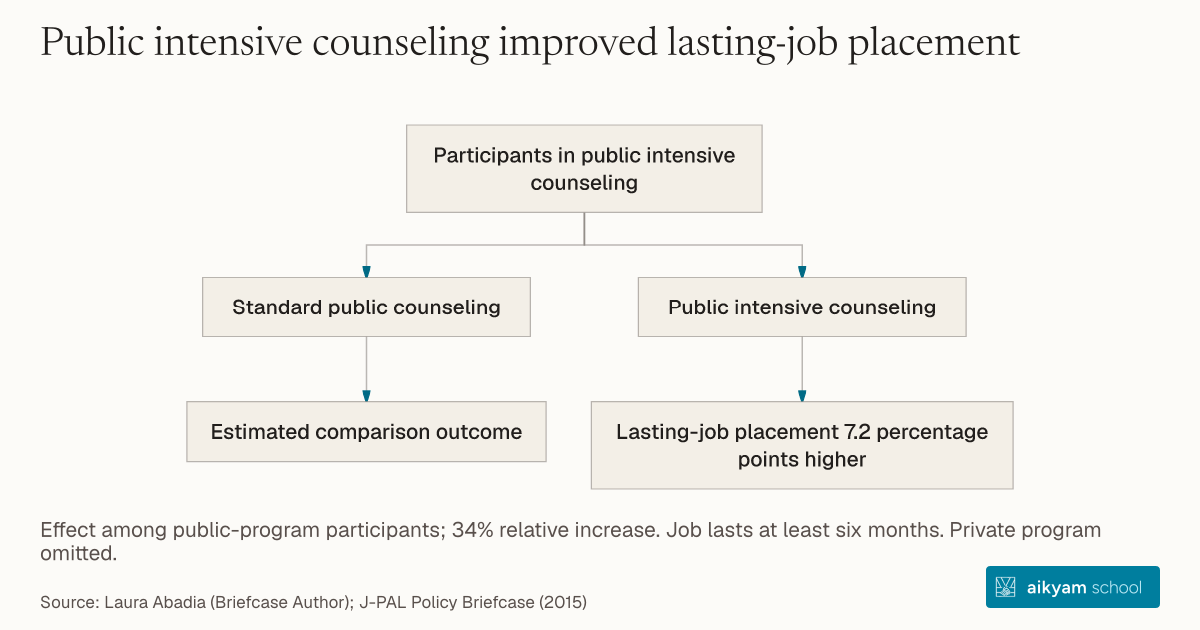
Participants in public intensive counseling
- Standard public counseling
- Estimated comparison outcome
- Public intensive counseling
- Lasting-job placement 7.2 percentage points higher
For public intensive participants, the estimated effect on finding a job lasting at least six months was +7.2 percentage points relative to their counterfactual standard counseling outcome. Effect among public-program participants; 34% relative increase. Job lasts at least six months. Private program omitted.
See source →Research question
Standard job placement evaluations frequently focus on short-term unemployment exits, which can encourage rapid placement into temporary or low-quality jobs. Evaluating long-term job retention measures whether counseling interventions produce durable worker-firm matches rather than temporary exits.
Participants
Nearly 44,000 job seekers entering unemployment entitled to at least one year of benefits across 216 local public employment offices in France.
Study Design
RCT evaluating Local Average Treatment Effect (LATE) estimates for employment lasting at least six months over a 12-month post-assignment period using administrative employment records.
Results
Public intensive counseling increased the probability of finding a job lasting at least six months by 34% (a 7.2 percentage point increase over the counterfactual). Private intensive counseling increased lasting job placement by 27% (a 5.0 percentage point increase).
Takeaway
Evaluate job counseling policy interventions based on 6-month and 12-month job retention rates rather than short-term 30-day placement benchmarks.
Source and citation
See source →Read alongside the research
Plain-English glossary
Original explanations, informed by the references below. Examples are illustrations, not data from the studies above. The research text stays unchanged.
- Percentage points
The difference between two percentages.
ExampleA rise from 40% to 50% is 10 percentage points. Relative to the starting value, that is a 25% increase.
Office for National Statistics · Percentages ↗Read more about percentage points →- Randomized controlled trial
A study that uses chance, like drawing lots, to decide who receives each option being compared. Researchers compare the groups’ outcomes to estimate the effect of those options.
ExampleA lottery assigns volunteers to a training programme or a comparison group. Researchers then compare their outcomes.
GET-IT glossary · Randomized study ↗Read more about randomized controlled trial →