In Simple Words
Imagine a multi-tool pocket knife with a blade, scissors, and a file—even if the main knife blade is dull, the scissors or file might be razor-sharp. Testing job-seekers across multiple distinct skill types ensures that almost every applicant discovers at least one specialized strength to show employers.
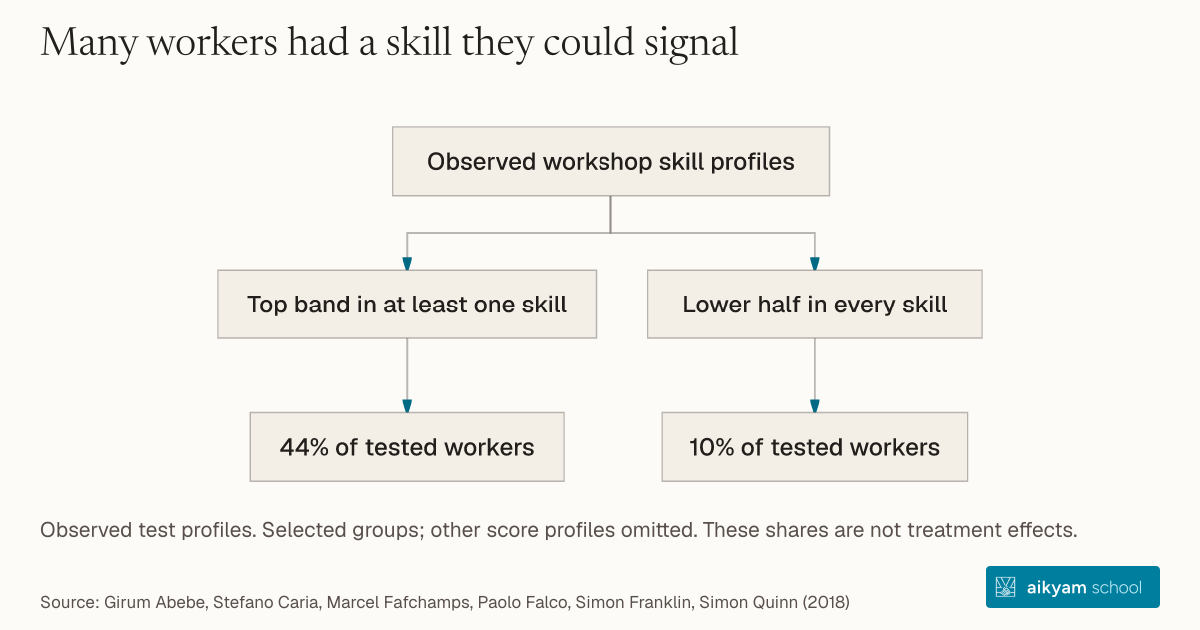
Observed workshop skill profiles
- Top band in at least one skill
- 44% of tested workers
- Lower half in every skill
- 10% of tested workers
Observed test profiles. Selected groups; other score profiles omitted. These shares are not treatment effects.
See source →Research question
A single composite score or overall grade causes lower-performing candidates to fear certification because it labels them as generally low-ability, discouraging disadvantaged youth from participating in signaling.
Participants
N = 469 tested workshop participants (youth job-seekers) in Addis Ababa, Ethiopia.
Study Design
Multi-dimensional test battery (Raven cognitive matrices, math, language, and 3 work samples) evaluated against endline earnings distribution via stochastic dominance tests.
Results
44% of participants scored in the top performance band for at least one skill, while only 10% scored in the lower half across all skills; as a result, earnings for the certified group strictly stochastically dominated control earnings.
Takeaway
Disaggregate applicant evaluations into independent skill category certificates (e.g., cognitive reasoning, linguistic accuracy, data entry speed) rather than releasing a single aggregate GPA or score.