In Simple Words
Think of keeping a detailed personal diary of every small odd job worked versus what is printed on a formal one-page job application form. A worker might tell a researcher in a survey about every week-long gig, but forget to update their printed application form for months. Because employers only see the printed application, relying on survey reports misrepresents the information available to recruiters.
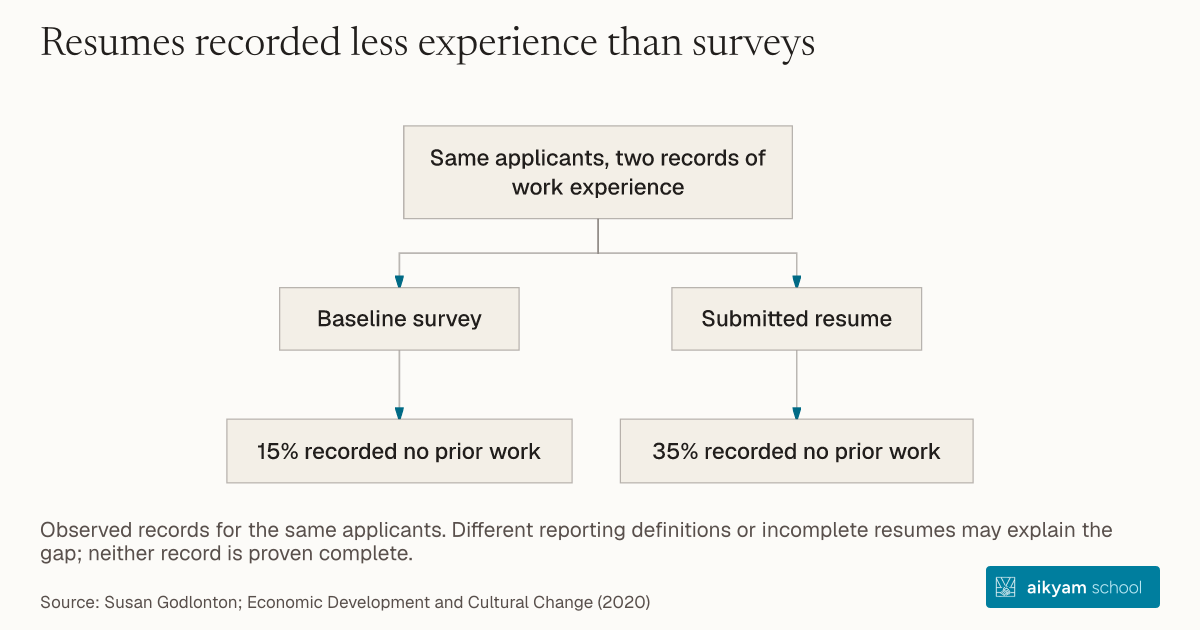
Same applicants, two records of work experience
- Baseline survey
- 15% recorded no prior work
- Submitted resume
- 35% recorded no prior work
Observed records for the same applicants. Different reporting definitions or incomplete resumes may explain the gap; neither record is proven complete.
See source →Research question
Labor market researchers often measure prior work experience using self-reported survey modules, whereas prospective employers observe experience only through job applicants' submitted résumés. Discrepancies between survey reports and resume records introduce systematic measurement error into hiring evaluations.
Participants
N = 268 male youth job seekers in Lilongwe, Malawi.
Study Design
Comparative analysis between self-reported baseline survey work history and formal résumé submissions.
Results
While only 15% of respondents reported no prior work experience in self-reported survey modules, 35% lacked work experience on their submitted résumés, revealing a 20 percentage point discrepancy caused by infrequent résumé updates and differing worker definitions of suitable CV entries.
Takeaway
Collect both formal résumé documents and retrospective survey histories to distinguish between employer-visible signals and actual worker history.
Source and citation
See source →Read alongside the research
Plain-English glossary
Original explanations, informed by the references below. Examples are illustrations, not data from the studies above. The research text stays unchanged.
- Baseline
The starting measurements in a study. Researchers use these to compare what participants were like at the start with what happens later.
ExampleBefore a training programme starts, researchers measure workers’ earnings. That first measurement is the baseline.
GET-IT glossary · Baseline characteristics ↗Read more about baseline →- Percentage points
The difference between two percentages.
ExampleA rise from 40% to 50% is 10 percentage points. Relative to the starting value, that is a 25% increase.
Office for National Statistics · Percentages ↗Read more about percentage points →