In Simple Words
Imagine a worker who reduces work hours by the exact same proportion for every thousand dollars received, whether the prize is small or huge, rather than ignoring small cash gifts and only taking time off work when the prize becomes massive.
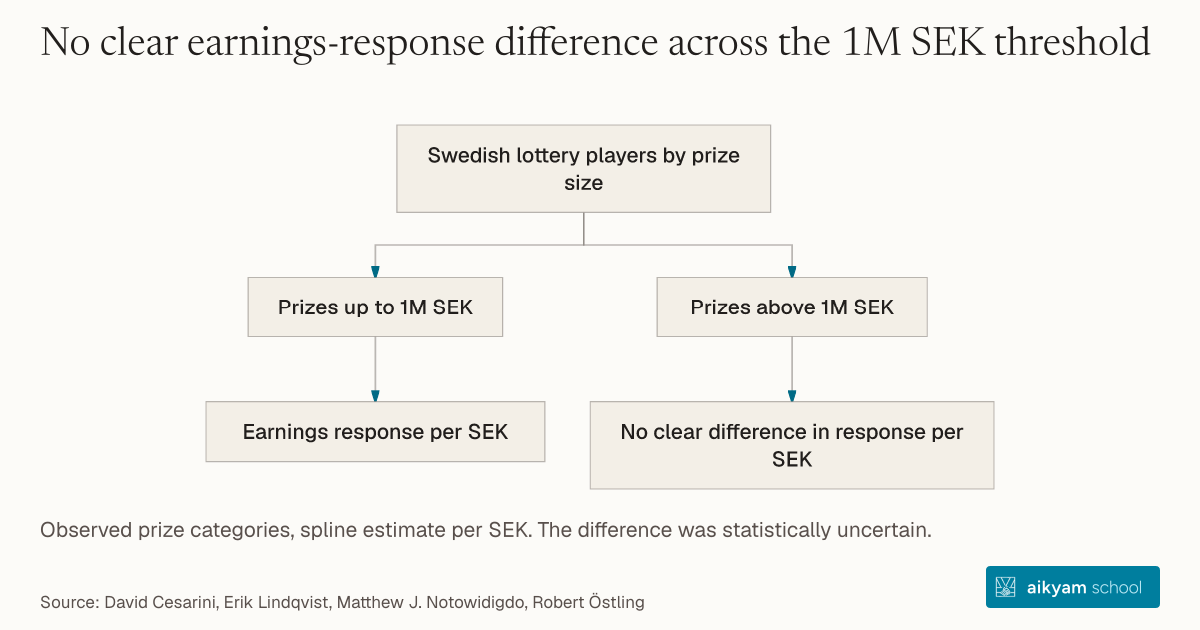
Swedish lottery players by prize size
- Prizes up to 1M SEK
- Earnings response per SEK
- Prizes above 1M SEK
- No clear difference in response per SEK
Observed prize-size categories in a spline regression with a 1M SEK knot. The smaller estimated marginal response above the knot was statistically uncertain.
See source →Research question
Fixed adjustment costs in changing work schedules predict that small financial windfalls produce negligible work adjustments, whereas large wealth shocks trigger disproportionately large labor cutbacks. Testing for non-linear marginal responses verifies whether labor adjustment costs distort small wealth transfers.
Participants
N = 244,826 observations of Swedish lottery winners across prize sizes ranging from under 1,000 SEK to over 5 million SEK.
Study Design
Quadratic and spline regression modeling with knots at 1M SEK, alongside sample trimming specifications excluding prizes exceeding 1M, 2M, or 5M SEK.
Results
Estimated marginal effects per unit of wealth are statistically indistinguishable across small, moderate, and large lottery prizes, rejecting hypotheses that fixed adjustment costs suppress labor supply responses to moderate wealth windfalls.
Takeaway
Apply linear marginal propensity to earn parameters uniformly across both small and large wealth transfer sizes when forecasting labor market responses.