In Simple Words
Think of a mandatory weekend study hall for students behind on homework. Many students work much harder during the week to finish their assignments on time simply to avoid having to show up for the study hall in the first place.
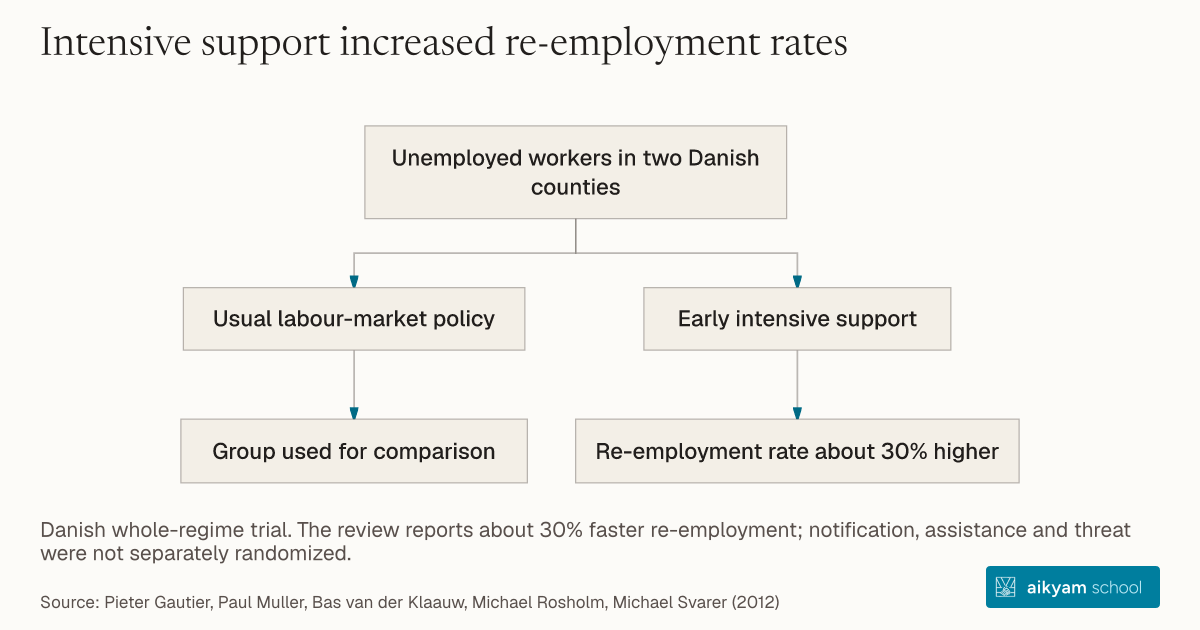
Unemployed workers in two Danish counties
- Usual labour-market policy
- Group used for comparison
- Early intensive support
- Re-employment rate about 30% higher
Danish whole-regime trial. The review reports about 30% faster re-employment; notification, assistance and threat were not separately randomized.
See source →Research question
Mandatory active labor market programs impose time and administrative costs on job seekers, creating behavioral incentives before or during treatment. Evaluations must distinguish between the direct skill-building value of program assistance and the motivating deterrence created by mandatory participation obligations.
Participants
N = 40,403 unemployed benefit applicants across 15 Danish counties (3,751 trial participants in Storstrøm and South Jutland) from November 2005 to February 2006.
Study Design
Randomized controlled trial and duration hazard modeling measuring exit rates to work, with distance-to-program heterogeneity checks.
Results
Mandatory activation increased re-employment rates by up to 30% (p < 0.01), driven substantially by threat effects before and early in program participation, with the strongest exit spikes occurring among workers facing the longest commute times to program locations.
Takeaway
Structure job search assistance programs with mandatory, early-stage participation milestones to leverage deterrence incentives that accelerate independent job search.
Source and citation
See source →Read alongside the research
Plain-English glossary
Original explanations, informed by the references below. Examples are illustrations, not data from the studies above. The research text stays unchanged.
- Randomized controlled trial
A study that uses chance, like drawing lots, to decide who receives each option being compared. Researchers compare the groups’ outcomes to estimate the effect of those options.
ExampleA lottery assigns volunteers to a training programme or a comparison group. Researchers then compare their outcomes.
GET-IT glossary · Randomized study ↗Read more about randomized controlled trial →