In Simple Words
Think of having a fixed-size suitcase on a trip; buying luggage insurance does not make the suitcase any bigger, but it allows you to swap out cheap bulky clothes for high-value delicate outfits.
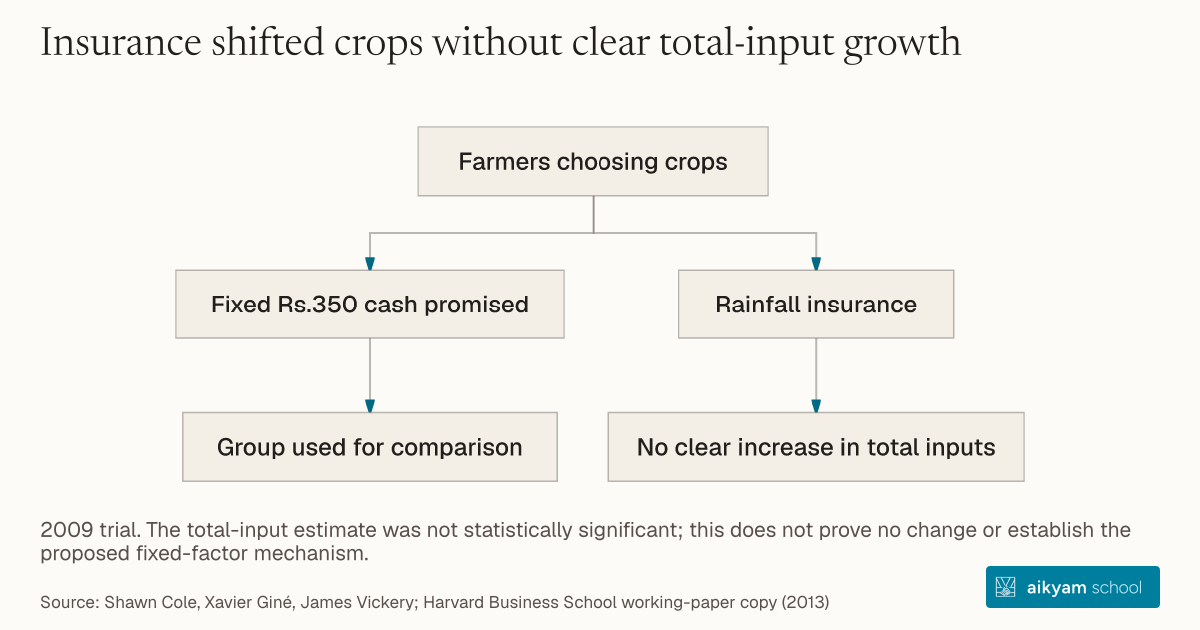
Farmers choosing crops
- Fixed Rs.350 cash promised
- Group used for comparison
- Rainfall insurance
- No clear increase in total inputs
2009 trial. The total-input estimate was not statistically significant; this does not prove no change or establish the proposed fixed-factor mechanism.
See source →Research question
Smallholder farmers face rigid short-run physical constraints on total land acreage and capital access, preventing overall expansion of farming scale when risk parameters improve.
Participants
N = 1,479 smallholder farming households in Andhra Pradesh, India.
Study Design
Econometric evaluation (Tobit and Probit models) comparing total land sown and total input expenditures versus cash-crop-specific allocations between insurance treatment and control groups.
Results
Insurance provision had no statistically significant effect on total land under cultivation (point estimate 0.029, p > 0.10) or total market value of all agricultural inputs used (point estimate 0.082, p > 0.10), acting entirely through compositional reallocation toward cash crops.
Takeaway
Evaluate agricultural risk interventions based on intra-portfolio input reallocation rather than expecting immediate expansion of total land under cultivation.
Source and citation
See source →Read alongside the research
Plain-English glossary
Original explanations, informed by the references below. Examples are illustrations, not data from the studies above. The research text stays unchanged.
- Statistically significant
A label used when a result passes a chosen statistical threshold, often p < 0.05. It does not show how large or useful an effect is. A result that is not statistically significant does not prove there is no effect.
ExampleA study reports p = 0.03 against a 0.05 threshold. It passes that test, but the effect could still be too small to matter.
American Statistical Association · Statement on p-values ↗Read more about statistically significant →