In Simple Words
Lowering friction and introducing soft features encourages users to initiate additional transactions more often, even if the average dollar amount per transfer remains unchanged.
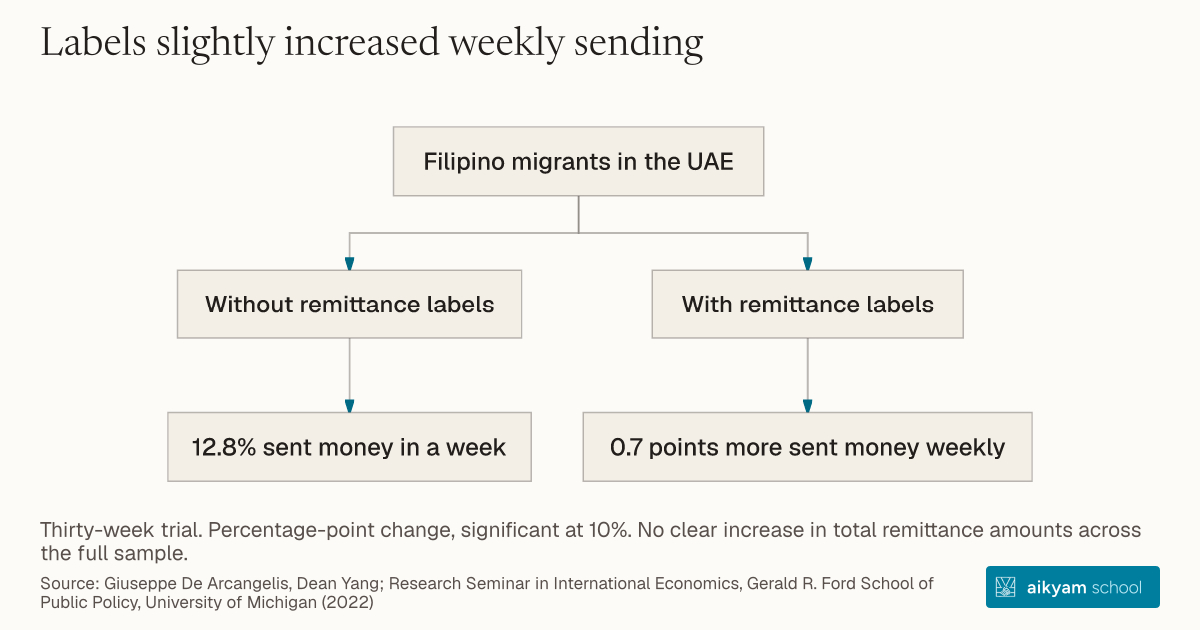
Filipino migrants in the UAE
- Without remittance labels
- 12.8% sent money in a week
- With remittance labels
- 0.7 points more sent money weekly
Thirty-week trial. Percentage-point change, significant at 10%. No clear increase in total remittance amounts across the full sample.
See source →Research question
Evaluating overall remittance intervention effectiveness often focuses on total cash volume, masking subtle shifts in transaction frequency and habits.
Participants
N = 4,451 Filipino migrant workers in UAE across 137,927 weekly observations over 30 weeks.
Study Design
30-week RCT intent-to-treat (ITT) OLS regression with individual and week fixed effects comparing treatment and control groups across transaction margins.
Results
Across the full sample, remittance labeling caused a statistically significant increase on the extensive margin of sending at least one weekly remittance (+0.007 probability, p < 0.10), while the effect on total weekly winsorized remittance amount (-29.78 PhP, p > 0.10) and total remittance index (+0.013, p > 0.10) was statistically non-significant.
Takeaway
Measure transaction frequency on the extensive margin alongside total transfer volume when testing financial technology innovations.
Source and citation
See source →Read alongside the research
Plain-English glossary
Original explanations, informed by the references below. Examples are illustrations, not data from the studies above. The research text stays unchanged.
- Randomized controlled trial
A study that uses chance, like drawing lots, to decide who receives each option being compared. Researchers compare the groups’ outcomes to estimate the effect of those options.
ExampleA lottery assigns volunteers to a training programme or a comparison group. Researchers then compare their outcomes.
GET-IT glossary · Randomized study ↗Read more about randomized controlled trial →- Statistically significant
A label used when a result passes a chosen statistical threshold, often p < 0.05. It does not show how large or useful an effect is. A result that is not statistically significant does not prove there is no effect.
ExampleA study reports p = 0.03 against a 0.05 threshold. It passes that test, but the effect could still be too small to matter.
American Statistical Association · Statement on p-values ↗Read more about statistically significant →