In Simple Words
Learning sophistication is like buying a gym membership thinking you will go every day, but after two months of failing, you realize your own laziness and start hiring a non-refundable personal trainer. Over time, personal experience forces individuals to acknowledge their self-control weaknesses and actively seek binding tools to keep themselves accountable.
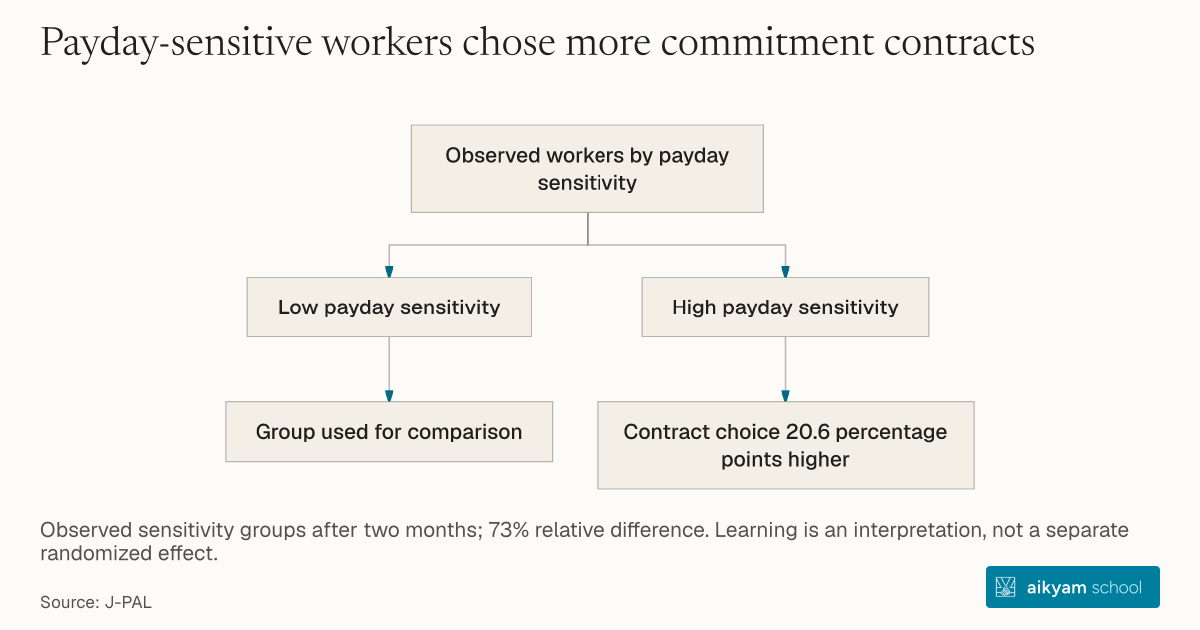
Observed workers by payday sensitivity
- Low payday sensitivity
- Group used for comparison
- High payday sensitivity
- Contract choice 20.6 percentage points higher
After two months high-payday-effect workers chose contracts 20.6 percentage points more often than low-payday-effect workers. This association does not separately prove learning caused the difference. Observed sensitivity groups after two months; 73% relative difference. Learning is an interpretation, not a separate randomized effect.
See source →Research question
Workers initially fail to recognize their own self-control flaws, leading to underutilization of commitment tools until workplace experience builds awareness of present bias.
Participants
N = 102 data entry workers in Mysore, India.
Study Design
Randomized Controlled Trial (RCT) tracking demand for commitment contracts over a two-month period across workers with varying degrees of payday sensitivity.
Results
After two months of work experience, workers with high payday sensitivity were 20.6 percentage points (73%) more likely to voluntarily select commitment contracts than low-payday-effect workers, and access to commitment contracts increased output by 9% for this group.
Takeaway
Establish probationary observation periods with clear productivity metrics so new hires can recognize their self-control gaps before opting into voluntary performance target programs.
Source and citation
See source →Read alongside the research
Plain-English glossary
Original explanations, informed by the references below. Examples are illustrations, not data from the studies above. The research text stays unchanged.
- Percentage points
The difference between two percentages.
ExampleA rise from 40% to 50% is 10 percentage points. Relative to the starting value, that is a 25% increase.
Office for National Statistics · Percentages ↗Read more about percentage points →- Randomized controlled trial
A study that uses chance, like drawing lots, to decide who receives each option being compared. Researchers compare the groups’ outcomes to estimate the effect of those options.
ExampleA lottery assigns volunteers to a training programme or a comparison group. Researchers then compare their outcomes.
GET-IT glossary · Randomized study ↗Read more about randomized controlled trial →