In Simple Words
Imagine telling someone "Don't worry, people won't think you look foolish in this uniform." Even if you add that past graduates felt proud, bringing up the word "foolish" reminds them that wearing the uniform might carry social embarrassment. Highlighting social judgment acts like turning on a spotlight on a potential risk, which often overpowers the reassurance meant to extinguish the fear.
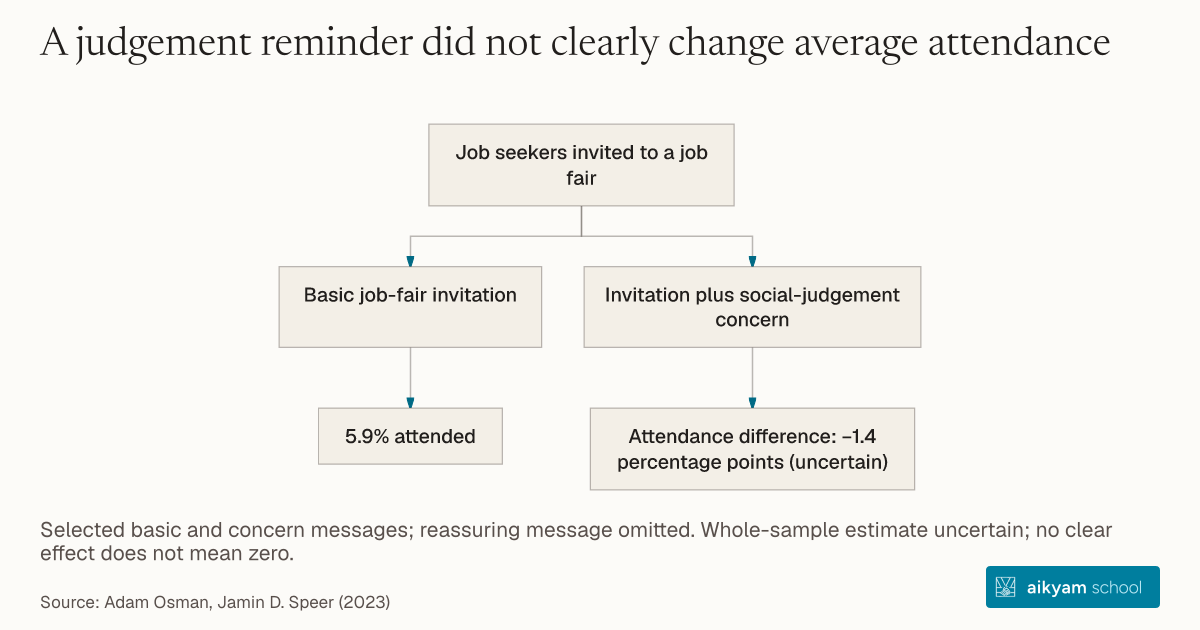
Job seekers invited to a job fair
- Basic job-fair invitation
- 5.9% attended
- Invitation plus social-judgement concern
- Attendance difference: −1.4 percentage points (uncertain)
For Experiment 2 as a whole, the basic invitation had a 5.9% attendance rate and the concern message had an estimated −1.4 percentage point difference. The estimate is not statistically significant. This selected two-message comparison does not establish the size of a reassurance effect or compare subgroup estimates.
See source →Research question
Messaging designed to reduce social stigma around entry-level jobs often unintentionally highlights the stigma itself, causing a negative reaction among jobseekers. When the negative salience effect outweighs the positive mitigation effect, recruitment interventions fail to increase program participation.
Participants
N = 768 jobseekers (Experiment 2), unemployed and underemployed youth aged 18–35 in Greater Cairo, Egypt.
Study Design
Randomized Field Experiment comparing a baseline control script, a salient stigma message ("some people might think these entry-level jobs are looked down on..."), and a dispelling stigma message adding alumni testimonials.
Results
Merely mentioning social stigma reduced job fair attendance by 1.4 percentage points overall and by 12.0 percentage points for the bottom predicted response group (p = 0.022). Adding testimonials attenuated this negative effect to -0.044 percentage points (statistically insignificant), demonstrating that salience forces can offset mitigation efforts.
Takeaway
Structure recruitment communications to highlight career advancement and positive alumni role models while completely avoiding language that names or frames social judgments and stigmas.
Source and citation
See source →Read alongside the research
Plain-English glossary
Original explanations, informed by the references below. Examples are illustrations, not data from the studies above. The research text stays unchanged.
- Percentage points
The difference between two percentages.
ExampleA rise from 40% to 50% is 10 percentage points. Relative to the starting value, that is a 25% increase.
Office for National Statistics · Percentages ↗Read more about percentage points →