In Simple Words
Tailored single-discipline training acts like assigning a specialized personal trainer who focuses exclusively on one weak muscle group rather than running a generic cross-training class. By matching a specific subject—like marketing or financial management—to the exact maturity level of the business, the owner absorbs and applies deep, relevant skills without cognitive overload.
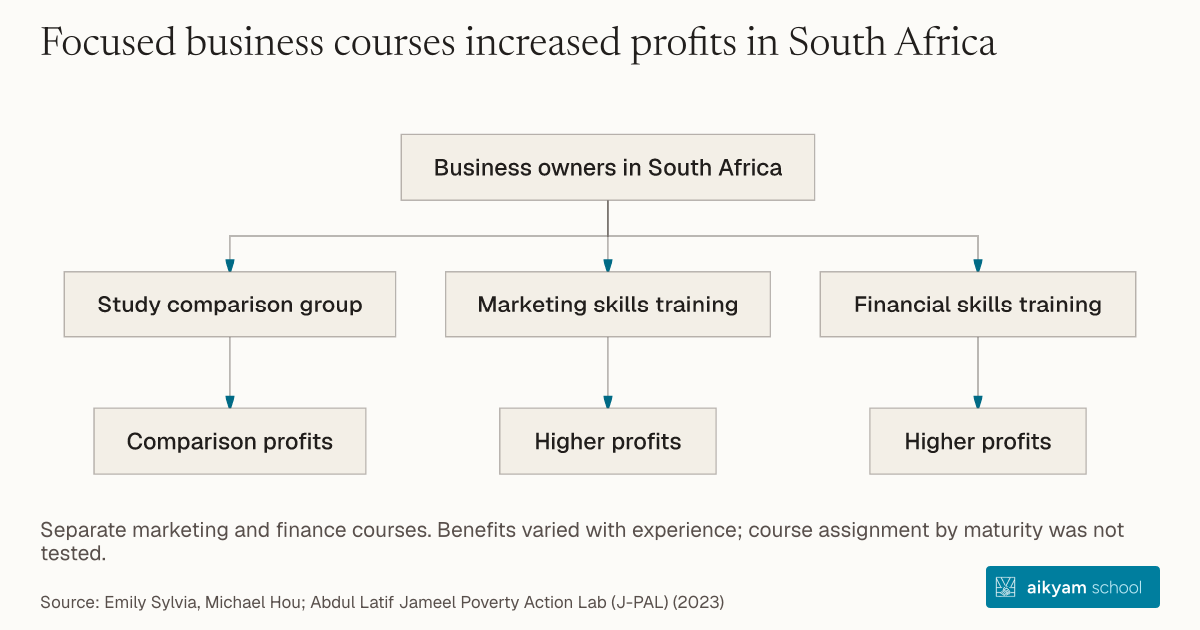
Business owners in South Africa
- Study comparison group
- Comparison profits
- Marketing skills training
- Higher profits
- Financial skills training
- Higher profits
Eight hours weekly for ten weeks, with separate marketing and finance curricula. Benefits varied by business experience; assigning courses by maturity was not separately tested.
See source →Research question
One-size-fits-all training programs present an overload of information by attempting to teach multiple business disciplines simultaneously to entrepreneurs at varying growth stages. Newer entrepreneurs require basic market growth strategies, whereas established business owners need financial efficiency optimization.
Participants
Human microentrepreneurs in South Africa categorized by business experience, employee count, and prior business sophistication.
Study Design
Randomized Controlled Trial (RCT) testing an intensive intervention of 8 hours of training per week for 10 weeks focused exclusively on either marketing or financial skills.
Results
Matching marketing skills to inexperienced firm owners and financial management skills to established firm owners resulted in large, sustained increases in both business practice adoption and firm profits.
Takeaway
Assess firm maturity and prior owner experience prior to course enrollment to direct novice owners into marketing-focused tracks and established owners into finance-focused tracks.
Source and citation
See source →Read alongside the research
Plain-English glossary
Original explanations, informed by the references below. Examples are illustrations, not data from the studies above. The research text stays unchanged.
- Randomized controlled trial
A study that uses chance, like drawing lots, to decide who receives each option being compared. Researchers compare the groups’ outcomes to estimate the effect of those options.
ExampleA lottery assigns volunteers to a training programme or a comparison group. Researchers then compare their outcomes.
GET-IT glossary · Randomized study ↗Read more about randomized controlled trial →