In Simple Words
Imagine asking someone to choose one family member to receive a $500 jackpot if their name is drawn from a hat. The person they name reveals who matters most to their financial planning, giving researchers a clear target for follow-up interviews.
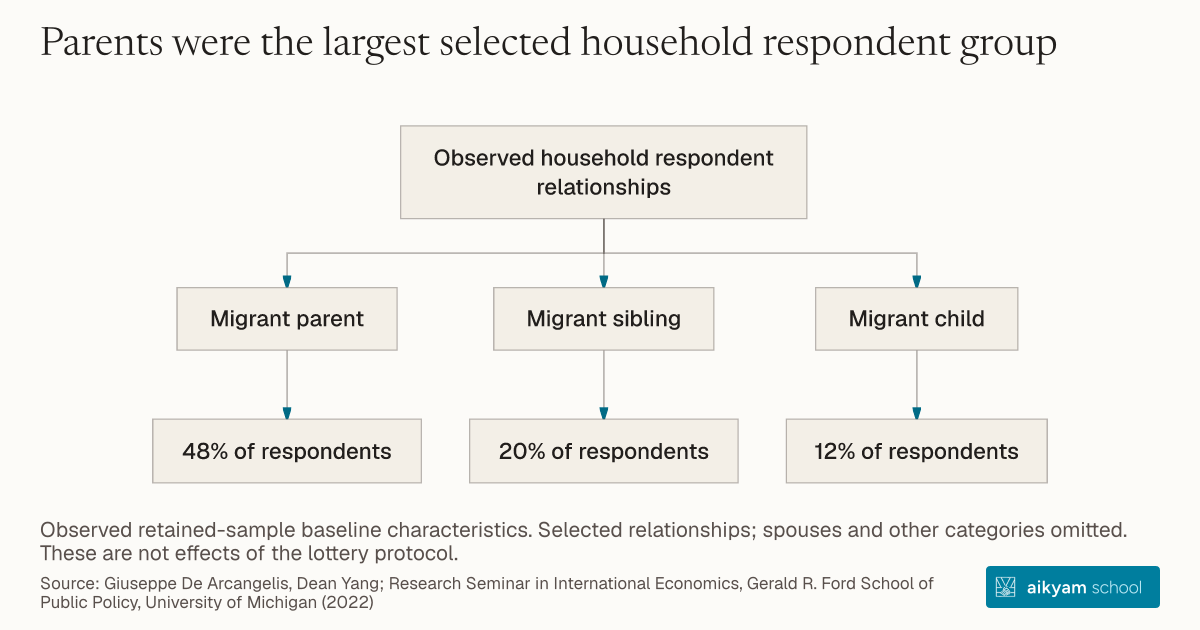
Observed household respondent relationships
- Migrant parent
- 48% of respondents
- Migrant sibling
- 20% of respondents
- Migrant child
- 12% of respondents
Observed retained-sample baseline characteristics. Selected relationships; spouses and other categories omitted. These are not effects of the lottery protocol.
See source →Research question
Migrants often send money to multiple individuals across extended social networks, making it difficult for researchers to objectively determine which recipient household is most central to the migrant's primary financial and welfare goals.
Participants
4,458 Filipino migrants naming target beneficiaries in the Philippines, resulting in 2,075 target household endline surveys.
Study Design
Administration of a $500 lottery prize nomination protocol in the baseline survey to identify the "target beneficiary" and paired "target household" for endline evaluation.
Results
Successfully identified key target household respondents—48% parents, 20% siblings, 10% spouses, and 12% children—establishing paired migrant-household linkages for 1,377 households at endline.
Takeaway
Use conditional prize nomination protocols during baseline migrant surveys to objectively pinpoint primary recipient households for downstream evaluation.
Source and citation
See source →Read alongside the research
Plain-English glossary
Original explanations, informed by the references below. Examples are illustrations, not data from the studies above. The research text stays unchanged.
- Follow-up
Collecting more information about participants later in a study to see what has happened to them. The term can also mean the length of time researchers keep track of them.
ExampleResearchers interview the same workers three months after a programme ends. That later interview is a follow-up.
GET-IT glossary · Follow-up ↗Read more about follow-up →- Baseline
The starting measurements in a study. Researchers use these to compare what participants were like at the start with what happens later.
ExampleBefore a training programme starts, researchers measure workers’ earnings. That first measurement is the baseline.
GET-IT glossary · Baseline characteristics ↗Read more about baseline →