In Simple Words
Capping eligibility at 30 credits is like allocating specialized driving instruction to student drivers who have mastered basic vehicle controls but haven't yet taken their highway test; drivers with hundreds of hours of experience no longer need the coaching, while complete novices may need basic mechanical lessons first.
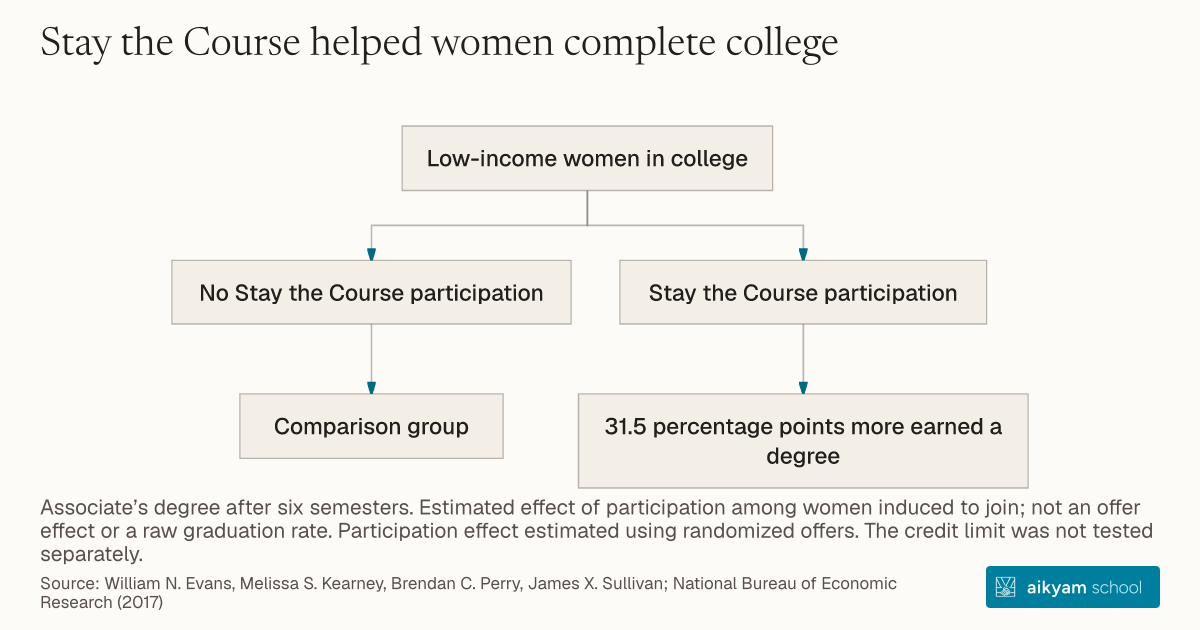
Low-income women in college
- No Stay the Course participation
- Comparison group
- Stay the Course participation
- 31.5 percentage points more earned a degree
Associate’s degree after six semesters. Estimated effect of participation among women induced to join; not an offer effect or a raw graduation rate. Participation effect estimated using randomized offers. The credit limit was not tested separately.
See source →Research question
Interventions aimed at raising degree completion often fail by targeting students who have already accumulated substantial credits and are already on a self-sustaining path to graduation, or conversely, students with zero credits who face extreme initial dropout volatility.
Participants
N = 1,168 total eligible study participants screened from 8,849 total campus students at Tarrant County College Trinity River Campus.
Study Design
RCT eligibility rule design enforcing an upper threshold of < 30 accumulated credit hours alongside low-income and TSI academic eligibility standards.
Results
Screening out students with > 30 accumulated credit hours successfully isolated a vulnerable cohort at risk of dropping out, yielding a 31.5 percentage point increase in female associate degree completion (TOT, p < 0.05).
Takeaway
Enforce a 30-credit upper limit during recruitment to focus intensive case management resources on students who remain at high risk of dropping out.
Source and citation
See source →Read alongside the research
Plain-English glossary
Original explanations, informed by the references below. Examples are illustrations, not data from the studies above. The research text stays unchanged.
- Percentage points
The difference between two percentages.
ExampleA rise from 40% to 50% is 10 percentage points. Relative to the starting value, that is a 25% increase.
Office for National Statistics · Percentages ↗Read more about percentage points →- Randomized controlled trial
A study that uses chance, like drawing lots, to decide who receives each option being compared. Researchers compare the groups’ outcomes to estimate the effect of those options.
ExampleA lottery assigns volunteers to a training programme or a comparison group. Researchers then compare their outcomes.
GET-IT glossary · Randomized study ↗Read more about randomized controlled trial →