In Simple Words
Adding new textbooks or supplies to a classroom where students cannot read basic letters is like giving advanced sheet music to someone who cannot read basic notes; without foundational understanding, additional materials remain completely unusable.
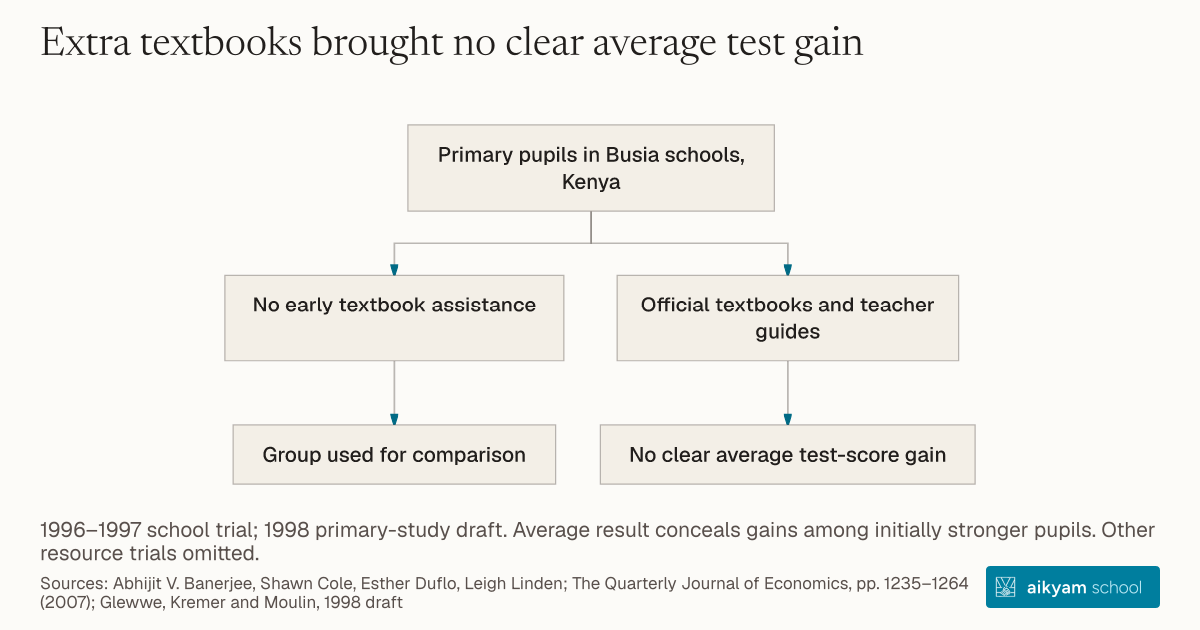
Primary pupils in Busia schools, Kenya
- No early textbook assistance
- Group used for comparison
- Official textbooks and teacher guides
- No clear average test-score gain
1996–1997 school trial; 1998 primary-study draft. Average result conceals gains among initially stronger pupils. Other resource trials omitted.
See source →Primary study: textbook trial, 1998 draft ↗Research question
Providing additional physical inputs or financial resources to underperforming schools fails to improve student test scores when the material is not adapted to student learning levels.
Participants
Synthesis of multiple randomized evaluations across primary school contexts in developing nations (e.g., Kenya, India).
Study Design
Systematic review of randomized controlled trials evaluating physical and personnel inputs (textbooks, flip charts, teacher headcount, meals, deworming).
Results
Providing unadapted textbooks, flip charts, or extra formal teachers produced zero statistically significant improvements (0.00 standard deviation) in average student test scores.
Takeaway
Audit educational spending to ensure additional physical or human resources directly target baseline learning deficits rather than expanding standard unadapted curriculum inputs.
Source and citation
See source →Read alongside the research
Plain-English glossary
Original explanations, informed by the references below. Examples are illustrations, not data from the studies above. The research text stays unchanged.
- Baseline
The starting measurements in a study. Researchers use these to compare what participants were like at the start with what happens later.
ExampleBefore a training programme starts, researchers measure workers’ earnings. That first measurement is the baseline.
GET-IT glossary · Baseline characteristics ↗Read more about baseline →- Statistically significant
A label used when a result passes a chosen statistical threshold, often p < 0.05. It does not show how large or useful an effect is. A result that is not statistically significant does not prove there is no effect.
ExampleA study reports p = 0.03 against a 0.05 threshold. It passes that test, but the effect could still be too small to matter.
American Statistical Association · Statement on p-values ↗Read more about statistically significant →