In Simple Words
Imagine a restaurant line cook who develops exceptional kitchen communication and crisis-solving abilities behind closed doors. Because outside restaurant owners can only inspect the cook's basic job title on a paper resume and cannot observe these interpersonal abilities during hiring, rival restaurants do not offer higher wages, allowing the current restaurant to retain the skilled cook without raising pay.
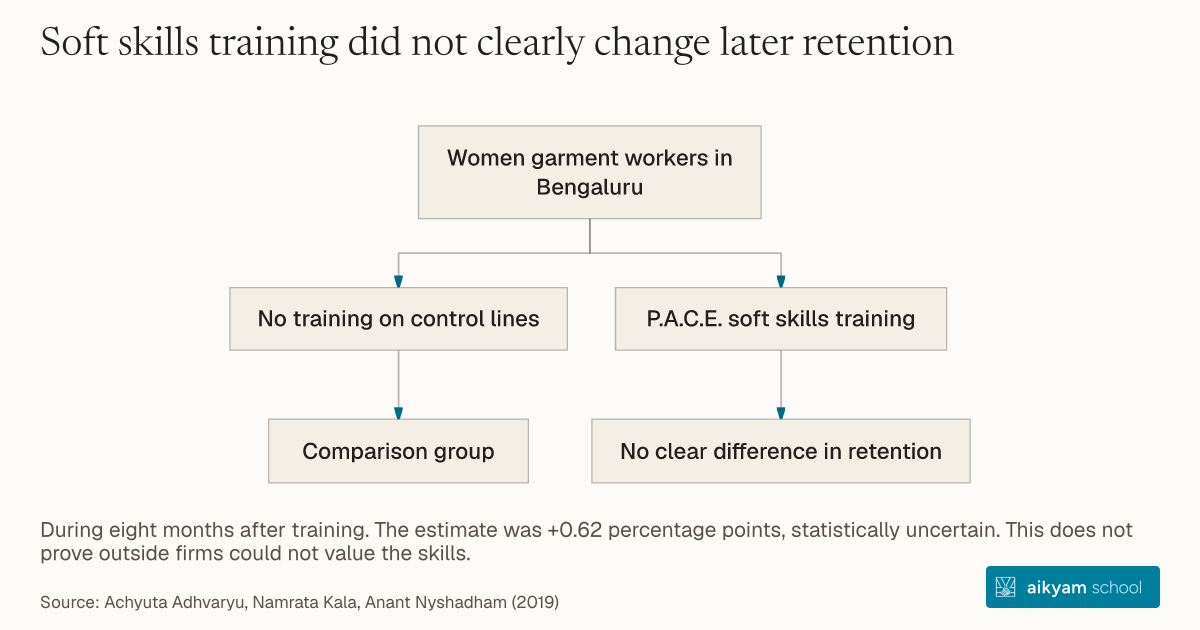
Women garment workers in Bengaluru
- No training on control lines
- Comparison group
- P.A.C.E. soft skills training
- No clear difference in retention
During eight months after training. The estimate was +0.62 percentage points, statistically uncertain. This does not prove outside firms could not value the skills.
See source →Research question
Standard human capital models predict that general soft skills training will induce employee poaching and wage bidding by outside firms, deterring employers from funding general workplace training.
Participants
N = 2,703 female garment workers followed across 1,433,981 daily attendance records and 28,692 monthly salary records in Bengaluru, India.
Study Design
Two-stage randomized controlled trial (RCT) tracking post-program worker retention and administrative monthly payroll salaries across treatment and control factories.
Results
Despite a 20 percent productivity increase (10.8 percentage point efficiency gain, p < 0.05), post-program long-run worker turnover showed zero differential retention or attrition (0.620 percentage points, p > 0.10) and wage increases remained negligible (0.492 percent, p < 0.10), proving that soft skills are unpriced by external labor markets due to unobservability.
Takeaway
Capitalize on the external unobservability of general soft skills to invest in employer-sponsored non-cognitive training without incurring increased turnover or wage inflation.
Source and citation
See source →Read alongside the research
Plain-English glossary
Original explanations, informed by the references below. Examples are illustrations, not data from the studies above. The research text stays unchanged.
- Percentage points
The difference between two percentages.
ExampleA rise from 40% to 50% is 10 percentage points. Relative to the starting value, that is a 25% increase.
Office for National Statistics · Percentages ↗Read more about percentage points →- Randomized controlled trial
A study that uses chance, like drawing lots, to decide who receives each option being compared. Researchers compare the groups’ outcomes to estimate the effect of those options.
ExampleA lottery assigns volunteers to a training programme or a comparison group. Researchers then compare their outcomes.
GET-IT glossary · Randomized study ↗Read more about randomized controlled trial →