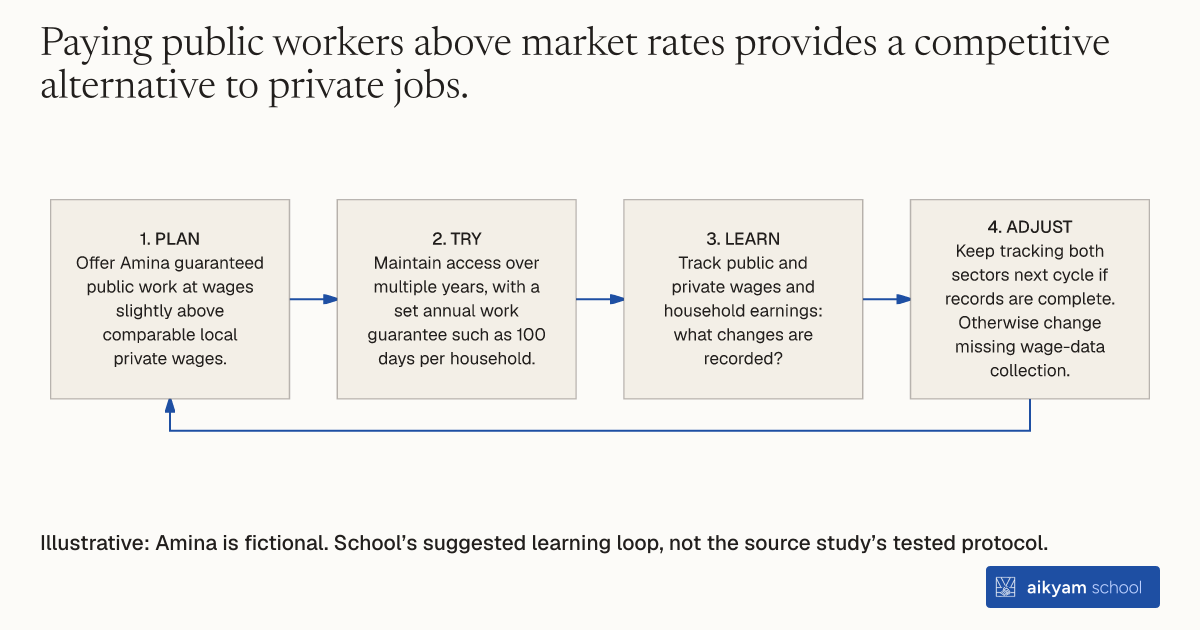
Try, learn and adjust
Track wages under a public employment guarantee
- Plan: Offer Amina guaranteed public work at wages slightly above comparable local private wages.
- Try: Maintain access over multiple years, with a set annual work guarantee such as 100 days per household.
- Learn: Track public and private wages and household earnings: what changes are recorded?
- Adjust: Keep tracking both sectors next cycle if records are complete. Otherwise change missing wage-data collection.
Illustrative: Amina is fictional. School’s suggested learning loop, not the source study’s tested protocol.
See source →School’s suggested learning loop: observe public and private wages and earnings. School’s loop does not establish that wage changes were caused by the programme.
How
When to use
Raise private sector wages for low-income workers across local labor markets where employers pay depressed market wages. Address low earnings among non-participants who do not join public employment schemes directly. Increase overall household income across large rural or urban populations through market-wide general equilibrium effects.
Set public employment wages above prevailing private market rates within large-scale multi-year workfare deployments.
- Design a large-scale public works program that offers guaranteed work opportunities across a targeted region or country.
- Establish public works wage rates slightly above prevailing local market wage rates for similar low-skilled labor.
- Guarantee worker access to public employment slots for a set number of days per year, such as 100 days per household.
- Maintain program availability over multi-year periods to establish a reliable wage floor across local economies.
- Induce local private sector employers to increase private wages to retain workers who would otherwise choose public employment.
Why it works
Private employers are forced to raise their own wages to attract and retain low-skilled labor in the local market.
Example
In India, the large-scale National Rural Employment Guarantee Act (NREGA) paid rural participants above prevailing market wages for up to 100 days of work per year, causing private sector wages to rise across local labor markets.
About the study
Participants
Millions of rural Indian households under the National Rural Employment Guarantee Act (NREGA) and urban workers in Ethiopia.
Study Design
Multi-year randomized controlled trial and spatial equilibrium modeling measuring public and private wage dynamics across program implementation sites.
Results
Eighty percent of the total participant earnings increase from NREGA resulted from boosted private sector earnings, while a similar multi-year program in Ethiopia increased private sector wages by 9 to 18 percent.