Research procedure
Model time until programme exit
- Track enrolment and exit dates
- Add time-dependent event indicators
- Specify the Weibull survival model
- Add household characteristics
- Estimate acceleration factors
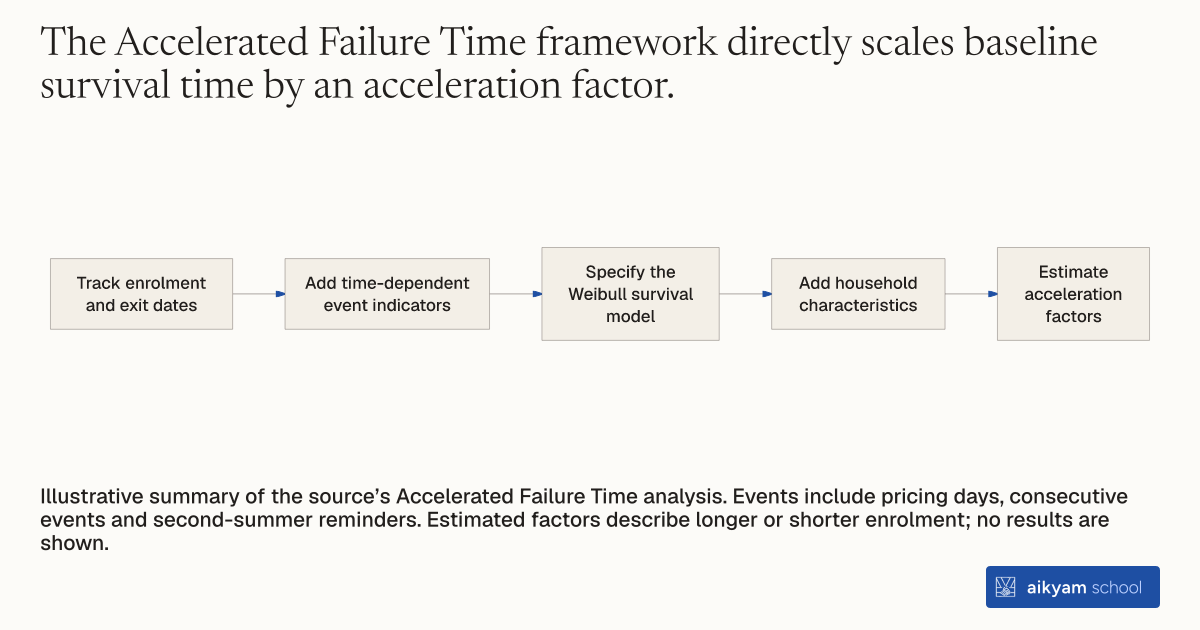
Illustrative summary of the source’s Accelerated Failure Time analysis. Events include pricing days, consecutive events and second-summer reminders. Estimated factors describe longer or shorter enrolment; no results are shown.
See source →How
When to use
Program evaluators and energy researchers need to model customer drop-out rates over time in multi-year electricity pricing programs. Standard proportional hazard models struggle to accommodate sudden discrete events like critical peak pricing days or reminder letters. Accelerated failure time hazard modeling estimates how specific operational events and household characteristics accelerate or delay customer drop-out timing.
Apply an Accelerated Failure Time model assuming a Weibull survival distribution to evaluate program attrition timing.
- Data analysts track enrollment duration and exact drop-out timestamps across enrolled treatment households over the pilot timeframe.
- Analysts construct time-dependent indicator variables for specific operational events, including Critical Peak Pricing event days, second-summer reminder mailings, and consecutive event strings.
- Analysts specify an Accelerated Failure Time regression model assuming a Weibull distribution parameterised by p.
- Analysts incorporate household-level covariates, including low-income status, structural winner status, and online portal registration.
- Econometricians estimate acceleration factors, where positive parameters indicate extended program survival time and negative parameters indicate accelerated attrition.
Why it works
This allows researchers to isolate the exact impact of discrete operational reminders and pricing event shocks on drop-out hazard rates.
Example
Researchers modeled program survival across 6,435 enrolled residential households in Sacramento, California, finding that receiving a second-summer reminder letter accelerated drop-out rates across treatment groups, while CPP opt-out households maintained a survival time 40 percent longer than CPP opt-in households.
About the study
Participants
6,435 enrolled residential households (2,110 TOU opt-in, 2,019 TOU opt-out, 1,585 CPP opt-in, 701 CPP opt-out) across 2,690,168 household-day observations in Sacramento, California.
Study Design
Accelerated Failure Time (AFT) Weibull regression survival analysis estimating time to program disenrollment.
Results
The second-summer reminder date strongly accelerated drop-outs (coefficient -4.252, p < 0.001), while CPP opt-out participants exhibited longer survival times (coefficient 0.339, corresponding to an acceleration factor of 1.40) compared to CPP opt-in households.