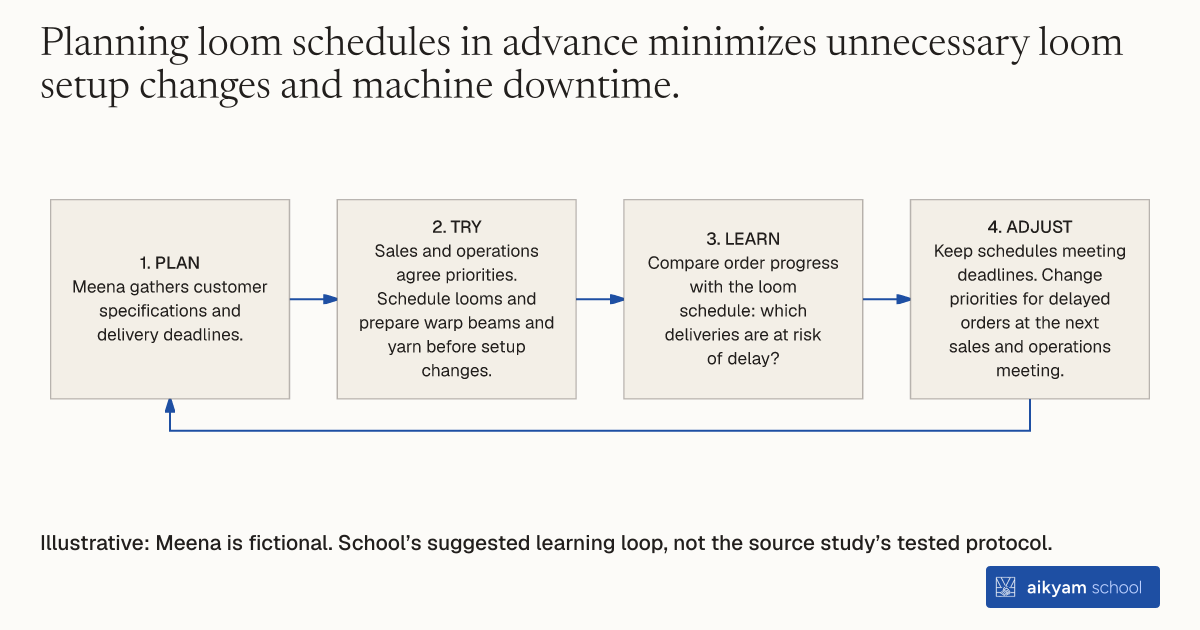
Try, learn and adjust
Check loom schedules against delivery deadlines
- Plan: Meena gathers customer specifications and delivery deadlines.
- Try: Sales and operations agree priorities. Schedule looms and prepare warp beams and yarn before setup changes.
- Learn: Compare order progress with the loom schedule: which deliveries are at risk of delay?
- Adjust: Keep schedules meeting deadlines. Change priorities for delayed orders at the next sales and operations meeting.
Illustrative: Meena is fictional. School’s suggested learning loop, not the source study’s tested protocol.
See source →Observe order progress, loom assignments and delivery deadlines. School suggests this learning loop; it is not the source’s tested procedure.
How
When to use
Textile factories often schedule loom production reactively as orders arrive without coordination between sales agents and plant managers. Plant supervisors change loom setups frequently without planning warp beam availability, causing loom downtime and missed customer delivery deadlines. This method helps plant directors schedule loom production in advance and hold regular coordination meetings between sales and operations teams.
Plan loom allocations in advance and hold regular meetings between sales and operational management to prioritize production orders.
- Sales managers collect order specifications and customer delivery deadlines from buyers.
- Sales and operational managers hold regular meetings to review order priorities and factory capacity.
- Production planners schedule loom assignments in advance based on fabric design specifications and order deadlines.
- Floor supervisors prepare warp beams and yarn lots prior to loom setup changes.
- Plant managers track order progress against the advance loom schedule to ensure on-time delivery.
Why it works
Holding regular meetings between sales and operational management aligns order delivery deadlines with factory floor capacity.
Example
International consultants helped woven cotton textile plants near Mumbai, India establish advance loom planning and regular sales-operations meetings, raising advance loom planning adoption from 42.9% to 64.3% in treatment plants.
About the study
Participants
28 plants across 17 large, family-owned cotton textile weaving firms in Tarapur and Umbergaon near Mumbai, India, averaging 273 employees and \$7.45 million in annual sales per firm.
Study Design
Randomized controlled trial providing 11 treatment firms with 5 months of management consulting and 6 control firms with 1 month of diagnostic consulting, tracking weekly data across ~100 weeks.
Results
Implementing advance loom planning and sales-operations coordination contributed to a 9.4% increase in output (p = 0.026) and a 16.6% increase in total factor productivity (p = 0.061), while advance loom planning adoption increased by 21.4 percentage points in treatment plants.