Try, learn and adjust
Check production against customer orders
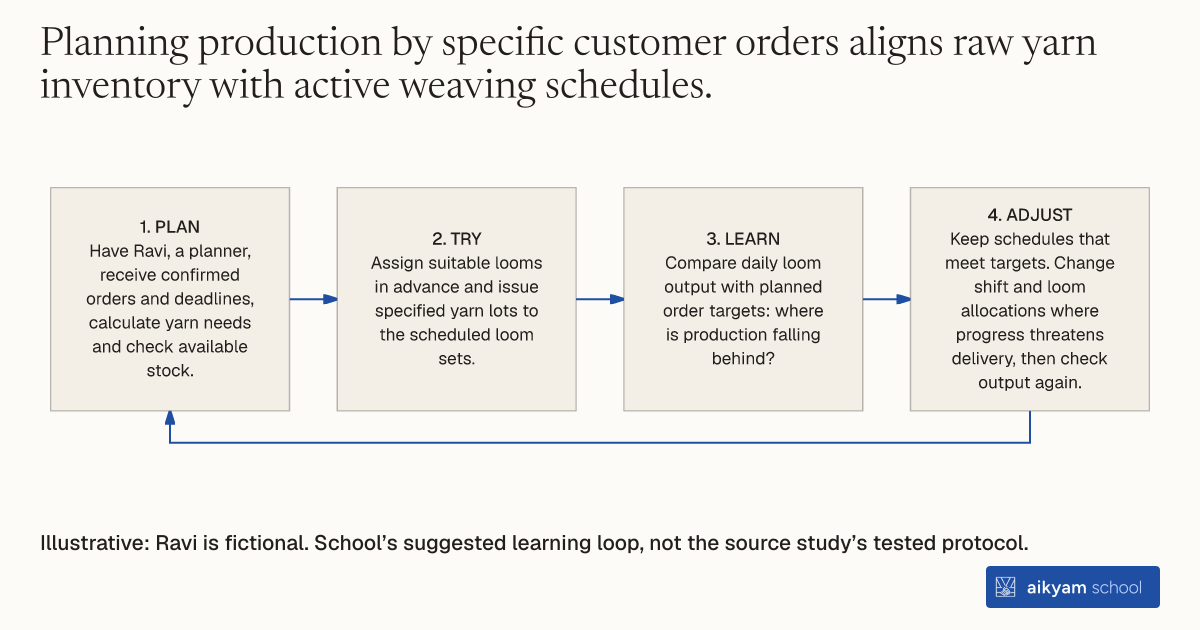
- Plan: Have Ravi, a planner, receive confirmed orders and deadlines, calculate yarn needs and check available stock.
- Try: Assign suitable looms in advance and issue specified yarn lots to the scheduled loom sets.
- Learn: Compare daily loom output with planned order targets: where is production falling behind?
- Adjust: Keep schedules that meet targets. Change shift and loom allocations where progress threatens delivery, then check output again.
Illustrative: Ravi is fictional. School’s suggested learning loop, not the source study’s tested protocol.
See source →School’s suggested, untested loop: observe order requirements, yarn availability, loom assignments and daily progress; on-time delivery is not assumed.
How
When to use
Manufacturing plants often assign client fabric orders to production lines without scheduling loom capacity in advance or logging specific order requirements. This method implements order-wise production planning and advance loom scheduling across weaving sheds. It helps plant managers and production schedulers optimize loom utilization, meet buyer delivery deadlines, and reduce yarn inventory holding costs.
Implement order-wise production planning and advance loom scheduling protocols to allocate raw materials and align machine capacity with customer orders.
- Sales managers transmit confirmed buyer fabric orders and delivery timelines directly to production planners upon order receipt.
- Production planners calculate exact yarn requirements and verify raw material availability before scheduling weaving shifts.
- Floor schedulers map loom assignments in advance to align loom specifications with fabric design specifications.
- Warehouse staff issue specific yarn lots to designated loom sets according to the advance production schedule.
- Plant managers monitor daily loom output against planned order targets to adjust shift schedules and prevent delivery delays.
Why it works
Advance loom scheduling prevents idle machine capacity and reduces yarn waste on factory floors.
Example
In 2008, international consultants introduced order-wise production planning and advance loom scheduling across experimental textile plants near Mumbai, India. Adoption of order-wise production planning grew from 67% of treatment plants in 2008 to 89% in 2011 and reached 100% in 2017, with zero adopting plants dropping the practice over nine years.
About the study
Participants
28 manufacturing plants across 17 family-owned cotton weaving firms near Mumbai, India, averaging 270 employees, \$8.5 million in assets, and \$7.5 million in annual sales.
Study Design
Randomized Controlled Trial (RCT) tracking 38 management practices across treatment and control plants from 2008 to 2017.
Results
Order-wise production planning adoption increased from 67% in 2008 to 89% in 2011 and reached 100% in 2017 with a 0% drop rate, while advance loom planning grew from 35% in 2008 to 55% in 2011 before declining to 10% in 2017.