Try, learn and adjust
Check attendance during after-school activities
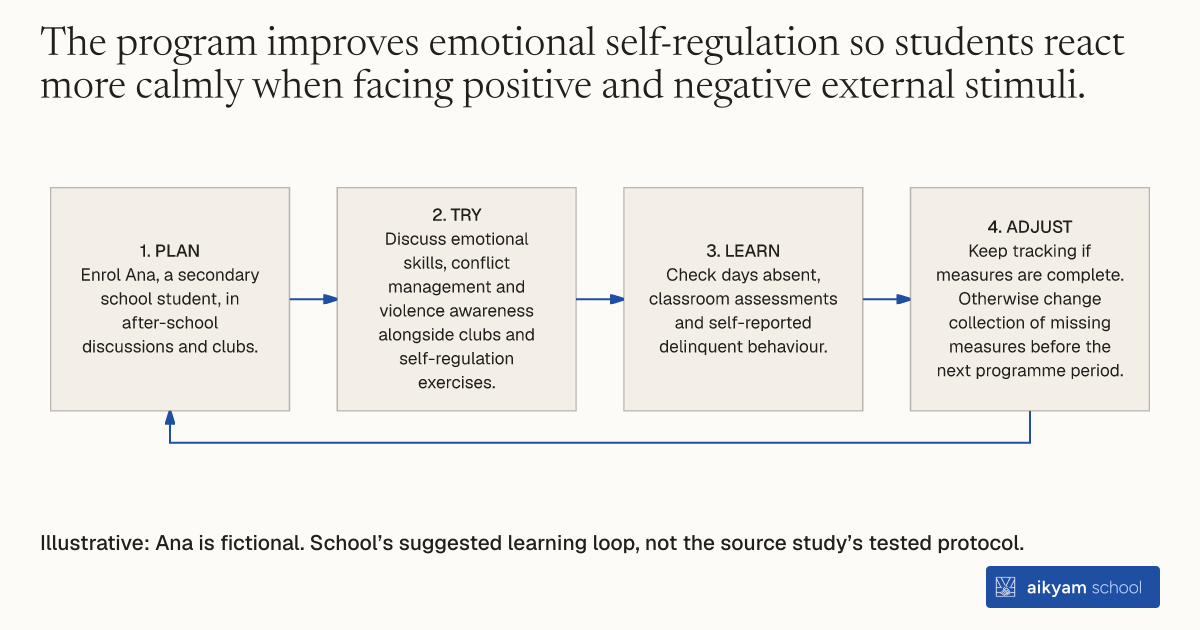
- Plan: Enrol Ana, a secondary school student, in after-school discussions and clubs.
- Try: Discuss emotional skills, conflict management and violence awareness alongside clubs and self-regulation exercises.
- Learn: Check days absent, classroom assessments and self-reported delinquent behaviour.
- Adjust: Keep tracking if measures are complete. Otherwise change collection of missing measures before the next programme period.
Illustrative: Ana is fictional. School’s suggested learning loop, not the source study’s tested protocol.
See source →School’s suggested learning loop, not the source’s tested procedure. Observe attendance, classroom assessments and self-reports. This check does not isolate the effect of any programme component.
How
When to use
Students in violent settings face emotional dysregulation and engage in delinquent and violent behaviors. School environments require structured after-school programming to foster calm responses to external stimuli. Implement an after-school socioemotional and club program for secondary school students to reduce delinquency and improve school performance.
Deliver an after-school program combining group discussions on socioemotional skills with student club activities.
- NGO facilitators enroll secondary school students in after-school programming.
- Facilitators lead group-based discussions focused on socioemotional skills, conflict management, and violence awareness.
- Program staff organize student club activities alongside socioemotional group discussions.
- Facilitators guide participants through emotional self-regulation exercises to build calm responses.
Why it works
Fostering conflict management skills reduces delinquent tendencies and keeps youth engaged in school.
Example
In El Salvador, NGO Glasswing delivered an after-school program combining socioemotional discussions, conflict management, and club activities to students. Eligible students recorded 1.6 fewer days absent per month, increased math and science grades by 0.11 and 0.13 standard deviations, and decreased delinquent behaviors.
About the study
Participants
Secondary school students in El Salvador.
Study Design
Randomized controlled trial measuring self-reported delinquent behavior, teacher classroom assessments, school absenteeism, grades, and neurophysiological self-regulation assessments.
Results
Reduced absenteeism by 1.6 days per month, increased math grades by 0.11 standard deviations, increased science grades by 0.13 standard deviations, and decreased delinquent and violent behaviors.