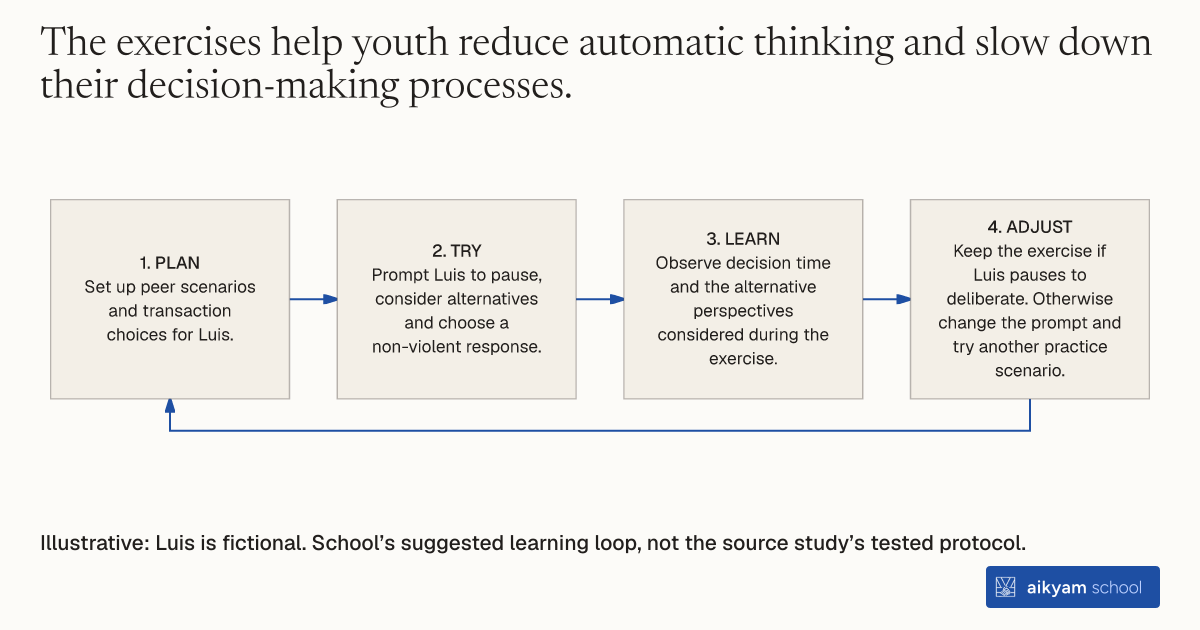
Try, learn and adjust
Check deliberation in role-play exercises
- Plan: Set up peer scenarios and transaction choices for Luis.
- Try: Prompt Luis to pause, consider alternatives and choose a non-violent response.
- Learn: Observe decision time and the alternative perspectives considered during the exercise.
- Adjust: Keep the exercise if Luis pauses to deliberate. Otherwise change the prompt and try another practice scenario.
Illustrative: Luis is fictional. School’s suggested learning loop, not the source study’s tested protocol.
See source →School’s suggested learning loop, not the source’s tested procedure. Observe decision time and responses in simulated interactions. This is not proof of reduced real-world violence.
How
When to use
Youth in high-stakes environments often respond to peer situations using rapid, default assumptions that escalate conflict. These automatic reactions lead to self-destructive decisions and violent behavior. Implement decision-slowing role-play and transaction exercises to help youth deliberate before responding in peer scenarios.
Use interactive games and role-playing scenarios to train participants to slow down their decision-making during high-stakes peer interactions.
- Program facilitators set up experiential role-playing games simulating real-world peer scenarios and transaction choices.
- Facilitators prompt youth to pause and evaluate the situation rather than reacting automatically.
- Facilitators guide participants to practice considering alternative perspectives during the exercise.
- Youth deliberate and select non-violent responses in simulated peer transactions.
Why it works
This allows participants to consider alternative perspectives and evaluate situations systematically before acting.
Example
Researchers tested male students in Chicago using a money transaction scenario game designed to evaluate decision-making. Students who participated in the program took about 80 percent more time than those in the comparison group to decide how to respond to a peer.
About the study
Participants
Male students in grades 7–10 in low-income Chicago Public Schools.
Study Design
Field experiment embedded in a randomized controlled trial assessing decision-making time during a peer transaction game.
Results
Program participants took about 80 percent more time than the comparison group to decide how to respond to a peer in a money transaction scenario.