Research procedure
Match subscription lottery winners to non-winners
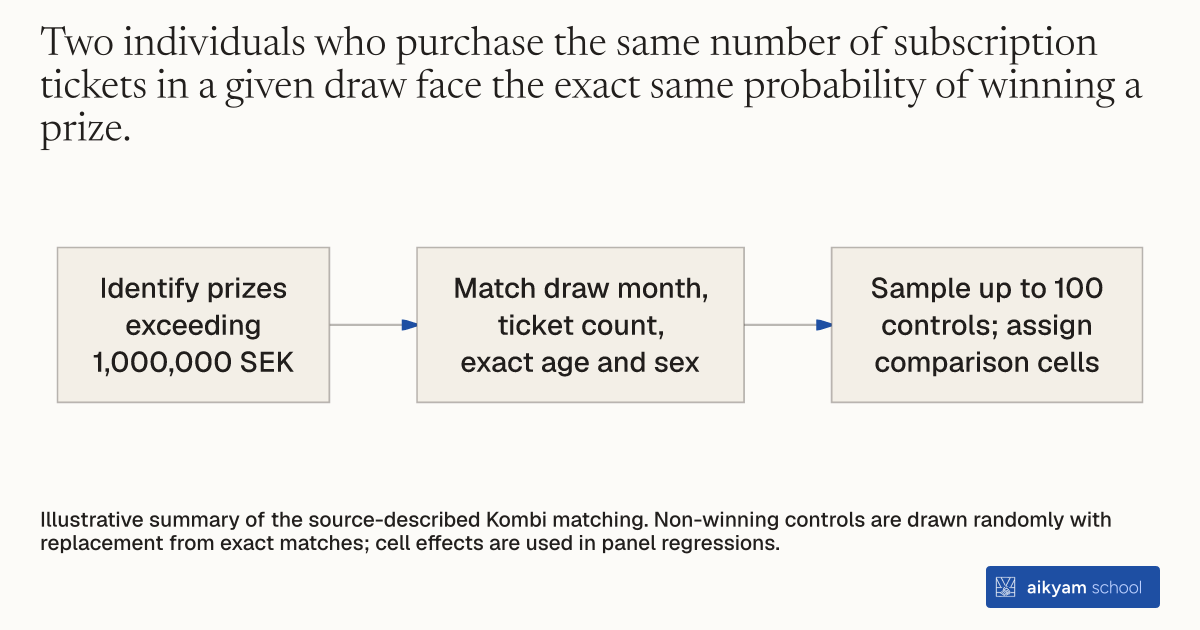
- Identify prizes exceeding 1,000,000 SEK
- Match draw month, ticket count, exact age and sex
- Sample up to 100 controls; assign comparison cells
Illustrative summary of the source-described Kombi matching. Non-winning controls are drawn randomly with replacement from exact matches; cell effects are used in panel regressions.
See source →How
When to use
Researchers need to isolate randomized lottery wealth shocks among subscribers in monthly ticket subscription lotteries. The chance of winning depends directly on the number of subscription tickets purchased by each subscriber. Matching each winning subscriber to non-winning subscribers who purchased the exact same number of tickets in that month creates balanced comparison groups.
Construct randomized comparison cells by matching each subscriber winning a large prize to non-winning subscribers holding identical ticket counts, age, and sex in that drawing month.
- Identify all subscribers participating in a monthly draw and identify players who won a prize exceeding 1,000,000 SEK.
- Determine the exact number of subscription tickets purchased by the winning subscriber in the month of the draw.
- Filter the pool of non-winning subscribers in that same draw month to those who hold an identical number of tickets.
- Restrict the eligible non-winning controls to subscribers of the exact same sex and age as the winning player.
- Draw up to 100 non-winning controls at random with replacement from the set of exact-matched eligible controls.
- Assign a unique cell fixed effect to the winner and the matched control group to isolate exogenous prize variation in panel regressions.
Why it works
Exact matching on age and sex removes demographic differences between winners and controls, increasing estimation precision without violating conditional random assignment.
Example
In the Swedish Kombi lottery between 1998 and 2010, researchers matched 262 winners of prizes exceeding 1M SEK to non-winning controls with identical ticket counts, age, and sex across 260 comparison cells.
About the study
Participants
24,172 observations of Swedish Kombi ticket subscribers aged 21 to 64 participating between 1998 and 2010.
Study Design
Econometric panel regression controlling for exact age-and-sex matched cell fixed effects to measure labor earnings responses to exogenous lottery prizes.
Results
Winning a lottery prize reduces annual pre-tax labor earnings by 1.066 SEK per 100 SEK won, with 5-year average pre-tax earnings falling by 5.48% per million SEK won.