Research procedure
Measure candidate connections through local informants
- Identify aggregators and pilot in early October
- Interview in the second and third October weeks
- Sum three connection scores into a 0 to 6 index
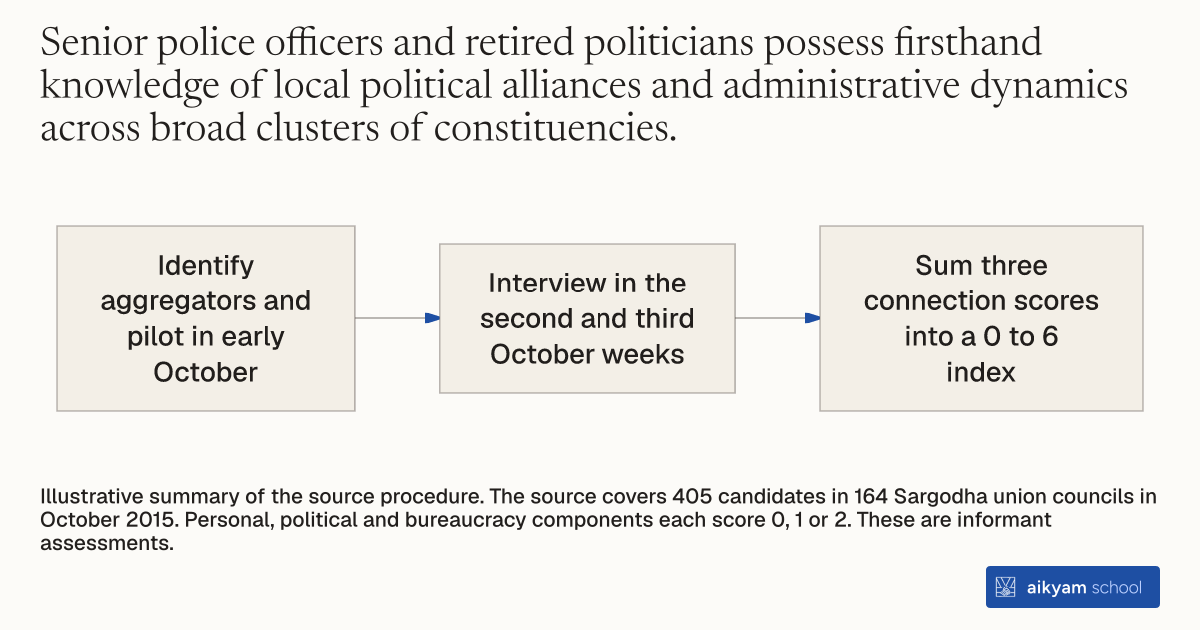
Illustrative summary of the source procedure. The source covers 405 candidates in 164 Sargodha union councils in October 2015. Personal, political and bureaucracy components each score 0, 1 or 2. These are informant assessments.
See source →How
When to use
Researchers need objective data on candidate ties to higher-tier politicians and local bureaucrats when official records do not track political networks. Individual candidates may misreport their own networks or exaggerate their political influence. This method gathers reliable data on political and bureaucratic connections across many candidates through independent local aggregators.
Measure candidate political and bureaucratic connections using key informant interviews with local aggregators.
- Identify local aggregators such as senior police officials and retired politicians by contacting prominent local leaders, administrative officials, and notables across union council clusters.
- Pilot survey protocols during the first week of October to refine assessment questions.
- Conduct key informant interviews with aggregators during the second and third weeks of October to evaluate all local chairman candidates.
- Score personal connections to sitting parliamentarians as 2 if connected to both the national assembly member and provincial assembly member, 1 if connected to one, and 0 if connected to neither.
- Score political connections from past campaign support as 2 if allied with both sitting parliamentarians, 1 if allied with one, and 0 if allied with neither.
- Score petty bureaucracy connections as 2 if the candidate resolves police and court issues with little effort, 1 if resolved with moderate effort, and 0 if unable to resolve any issues.
- Sum the three component scores into an aggregate connectedness index ranging from 0 to 6.
Why it works
Aggregating standardized scores across independent key informants provides consistent data across hundreds of candidates.
Example
Researchers surveyed aggregators across 164 rural union councils in Sargodha district in October 2015 to score 405 local chairman candidates on personal, political, and bureaucratic ties, creating an index ranging from 0 to 6.
About the study
Participants
Key informant evaluations for 405 candidates across 164 union councils in Sargodha district, Punjab province, Pakistan.
Study Design
Key informant aggregator survey using structured scoring protocols across personal, political, and bureaucratic domains.
Results
Candidates at the top of the aggregate connectedness index achieved a 9.5 percentage point higher vote share and were 26 percentage points more likely to win office.