Try, learn and adjust
Check restricted agricultural power hours
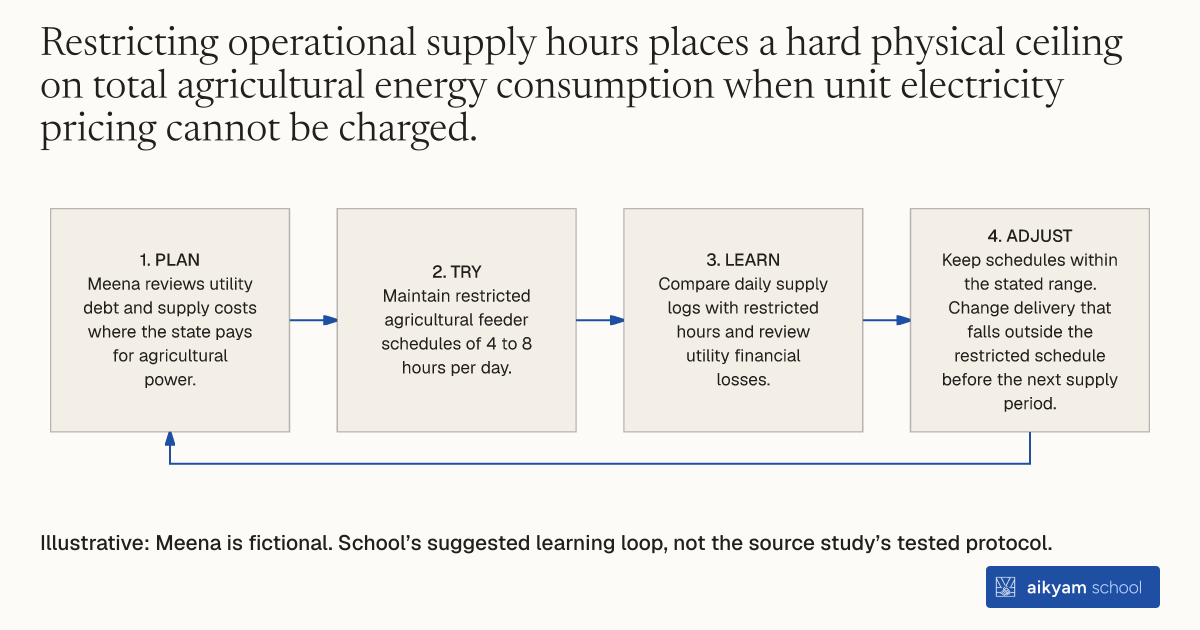
- Plan: Meena reviews utility debt and supply costs where the state pays for agricultural power.
- Try: Maintain restricted agricultural feeder schedules of 4 to 8 hours per day.
- Learn: Compare daily supply logs with restricted hours and review utility financial losses.
- Adjust: Keep schedules within the stated range. Change delivery that falls outside the restricted schedule before the next supply period.
Illustrative: Meena is fictional. School’s suggested learning loop, not the source study’s tested protocol.
See source →School’s suggested learning loop checks hours and costs, separately from the described rationing policy; it does not establish debt reduction.
How
When to use
Providing unmetered free agricultural electricity causes unsustainable growth in energy subsidies and public debt. State power distribution utilities cannot recover costs per unit of energy supplied to farmers. This method controls public utility expenditures and fiscal losses by restricting daily power delivery duration.
Control state power utility financial deficits by capping daily electricity supply hours to agricultural tube wells.
- The state power distribution utility monitors expanding debt from unmetered agricultural electricity subsidies.
- The government bears the cost of every unit of power supplied for agricultural irrigation.
- Utility operators restrict agricultural feeder electricity supply to between 4 and 8 hours per day.
- The state power distribution utility maintains restricted supply schedules to manage fiscal losses while providing necessary irrigation power.
Why it works
Capping supply hours limits total expenditure for state utilities bearing the full cost of agricultural power.
Example
The Punjab State Power Corporation Limited rationed agricultural electricity to 4 to 8 hours per day in Punjab, India, to manage about US\$ 3 billion in outstanding utility debt.
About the study
Participants
300 agricultural feeders supplying 50 to 150 farmers each across 6 districts in Punjab, India.
Study Design
Observational baseline assessment of state utility debt and agricultural supply logs within a cluster randomized controlled trial framework.
Results
Electricity supply to agricultural tube wells is restricted to 4 to 8 hours per day to manage fiscal losses associated with about US\$ 3 billion in outstanding state utility debt.