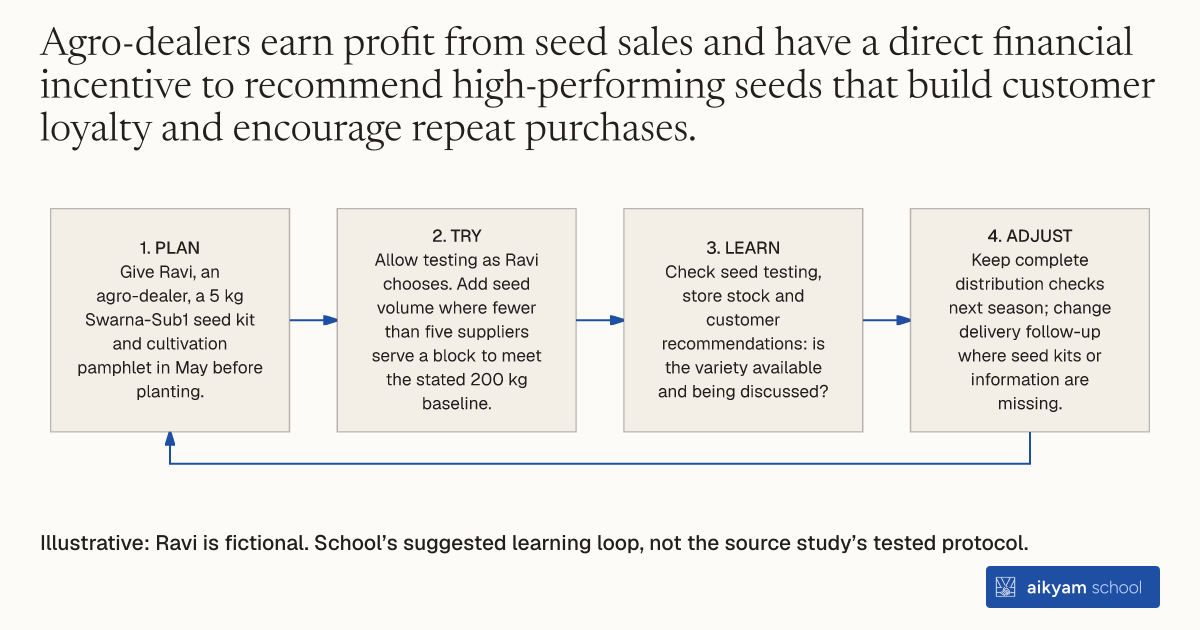
Try, learn and adjust
Check seed kits reach local dealers
- Plan: Give Ravi, an agro-dealer, a 5 kg Swarna-Sub1 seed kit and cultivation pamphlet in May before planting.
- Try: Allow testing as Ravi chooses. Add seed volume where fewer than five suppliers serve a block to meet the stated 200 kg baseline.
- Learn: Check seed testing, store stock and customer recommendations: is the variety available and being discussed?
- Adjust: Keep complete distribution checks next season; change delivery follow-up where seed kits or information are missing.
Illustrative: Ravi is fictional. School’s suggested learning loop, not the source study’s tested protocol.
See source →School’s suggested, untested learning loop. Observe kit delivery, testing, stock and recommendations; no adoption increase is assumed from this check.
How
When to use
Smallholder farmers face severe crop losses during seasonal flooding but rarely adopt flood-tolerant seed varieties due to lack of awareness and poor seed availability in local markets. Traditional public extension relies on lead farmers who lack direct economic incentives to spread new seeds. Delivering trial seed kits and informational pamphlets directly to local commercial agro-dealers addresses this bottleneck by motivating vendors to stock and recommend resilient varieties to local growers.
Deliver trial seed kits and educational materials directly to local agricultural input suppliers prior to planting season.
- Identify commercial input suppliers operating within target rural administrative blocks.
- Deliver a trial kit containing 5 kilograms of Swarna-Sub1 flood-tolerant rice seeds to each agro-dealer in May before the planting season.
- Provide a small informational pamphlet detailing the features, benefits, and proper cultivation methods of the seed variety to each dealer alongside the seed kit.
- Supply additional seed volume to existing dealers in blocks with fewer than five suppliers to ensure a baseline introduction of 200 kilograms of seed per administrative block.
- Allow dealers to plant or test seeds as they wish so they learn about variety quality and pass recommendations directly to customer farmers.
Why it works
Providing dealers with early access and physical samples builds product confidence, prompting them to actively inform potential buyers and stock the variety in their stores.
Example
Researchers worked with the Odisha Ministry of Agriculture in May 2016 to deliver 5 kg seed kits of Swarna-Sub1 rice and informational pamphlets to five agro-dealers across 36 administrative blocks in Odisha, India. Fifteen months later, farmer adoption of Swarna-Sub1 reached 9.8 percent compared to 6.3 percent in standard extension blocks, and high-risk flood-prone farmers increased adoption by 6.4 percentage points.
About the study
Participants
72 administrative blocks comprising approximately 136 villages each across 10 flood-prone coastal districts in Odisha, India, targeting smallholder farmers and rural agro-dealers.
Study Design
Randomized controlled trial comparing 36 blocks receiving agro-dealer focused extension services against 36 blocks receiving standard government extension services between 2016 and 2018, evaluated using farmer surveys, dealer inventory checks, secret shopper audits, and remote sensing flood risk mapping.
Results
Agro-dealer extension increased farmer Swarna-Sub1 adoption by 3.5 percentage points (a 56 percent increase from a 6.3 percent baseline) after 15 months, expanded cultivation by 0.06 acres per farmer (a 69 percent increase), boosted adoption among high-risk flood-exposed farmers by 6.4 percentage points, increased dealer stocking probability by 11.4 percentage points (a 59 percent increase), raised secret shopper dealer recommendations by 13 percentage points (a 25 percent increase), and increased local seed production by 57 percent over three years.