Try, learn and adjust
Check seed stocking and purchases through local dealers
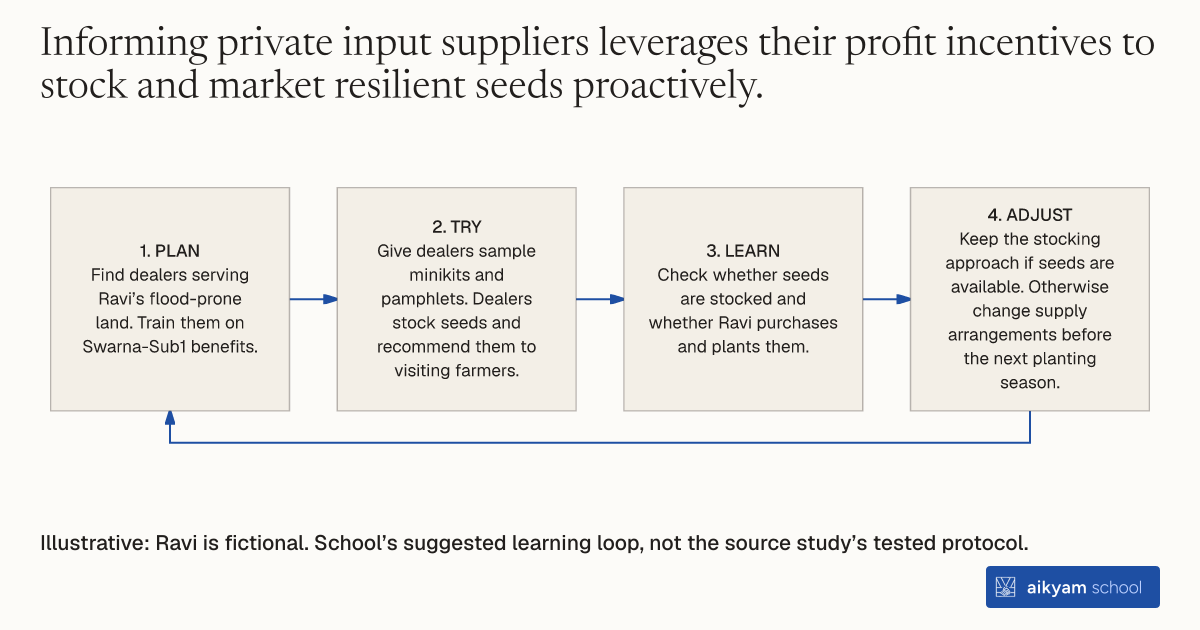
- Plan: Find dealers serving Ravi’s flood-prone land. Train them on Swarna-Sub1 benefits.
- Try: Give dealers sample minikits and pamphlets. Dealers stock seeds and recommend them to visiting farmers.
- Learn: Check whether seeds are stocked and whether Ravi purchases and plants them.
- Adjust: Keep the stocking approach if seeds are available. Otherwise change supply arrangements before the next planting season.
Illustrative: Ravi is fictional. School’s suggested learning loop, not the source study’s tested protocol.
See source →School’s suggested learning loop: observe seed availability, purchases and planting; this is not a separate test of adoption effects.
How
When to use
Public agricultural extension networks often fail to reach remote smallholder farmers with new seed varieties. Providing private input dealers with targeted training and sample minikits leverages existing retail channels. This helps smallholders in flood-prone areas access flood-tolerant seeds through local commercial suppliers.
Train private agro-dealers and provide them with sample minikits to promote seed adoption through commercial retail channels.
- Extension managers identify flood-prone administrative blocks and locate local private input dealers.
- Field staff deliver targeted training to agro-dealers regarding the benefits of Swarna-Sub1 seeds.
- Program staff supply dealers with sample seed minikits and informational pamphlets for their stores.
- Agro-dealers stock Swarna-Sub1 seeds and recommend them to visiting farmers with flood-prone land.
- Smallholder farmers purchase seeds from local dealers and cultivate them on their plots.
Why it works
Dealers guide the technology directly to flood-exposed farmers who gain the highest economic returns.
Example
In 72 administrative blocks across 10 flood-prone districts in Odisha, researchers provided agro-dealers with extension services, minikits, and informational pamphlets. Farmers in participant blocks achieved a 9.8 percent seed adoption rate compared to 6.3 percent under traditional extension.
About the study
Participants
72 blocks in 10 flood-prone districts in Odisha, India.
Study Design
Randomized evaluation comparing blocks where private agro-dealers received extension services, minikits, and pamphlets against comparison blocks receiving traditional government extension activities.
Results
Farmers in blocks where agro-dealers received extension services were 56 percent more likely to adopt Swarna-Sub1 compared to those receiving traditional extension (9.8 percent increase in adoption compared to 6.3 percent).