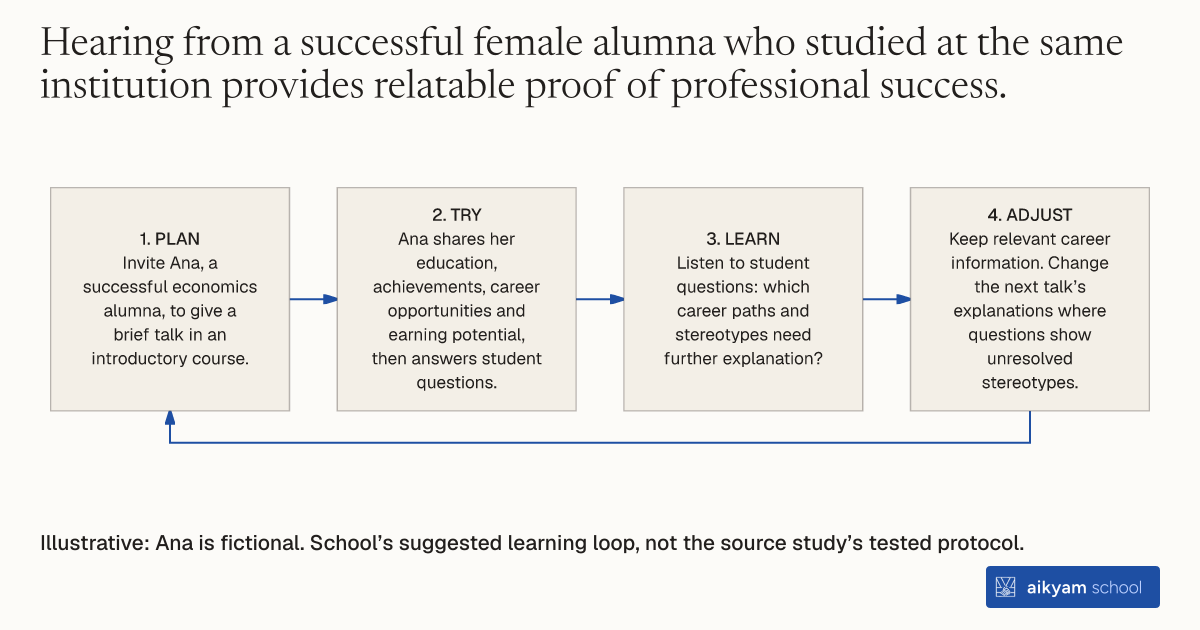
Try, learn and adjust
Check an alumna’s talk covers careers and questions
- Plan: Invite Ana, a successful economics alumna, to give a brief talk in an introductory course.
- Try: Ana shares her education, achievements, career opportunities and earning potential, then answers student questions.
- Learn: Listen to student questions: which career paths and stereotypes need further explanation?
- Adjust: Keep relevant career information. Change the next talk’s explanations where questions show unresolved stereotypes.
Illustrative: Ana is fictional. School’s suggested learning loop, not the source study’s tested protocol.
See source →School’s suggested, untested loop. Observe student questions and topics covered; do not infer changes in major choice.
How
When to use
Women remain underrepresented in economics and STEM fields due to a lack of female role models in college. This gap leads female students toward lower-earning academic majors. Arrange brief visits where successful female alumni speak to students in introductory college classes.
Invite successful female alumni to give short classroom speeches to students taking introductory economics courses.
- Select female alumni who achieved professional success in economics or related fields.
- Schedule brief guest presentation visits during introductory undergraduate course lectures.
- Deliver a short speech sharing personal educational experiences and professional achievements.
- Discuss career opportunities, future earning potential, and the practical value of majoring in economics.
- Answer student questions to address stereotypes about career paths in the field.
Why it works
It shifts career preferences and encourages women to pursue higher-earning quantitative majors.
Example
At a college in the United States, a short speech given by a woman economist at her alma mater increased the proportion of female students majoring in economics from 9 percent to 17 percent.
About the study
Participants
Undergraduate college students in introductory economics courses in the United States.
Study Design
Randomized evaluation testing classroom visits by female alumni against a comparison group.
Results
The likelihood of female students majoring in economics increased by 8 percentage points, from 9 percent to 17 percent, while decreasing enrollment in lower-earning majors; male students showed no change in majoring choices.