Try, learn and adjust
Check a scientist’s talk addresses career stereotypes
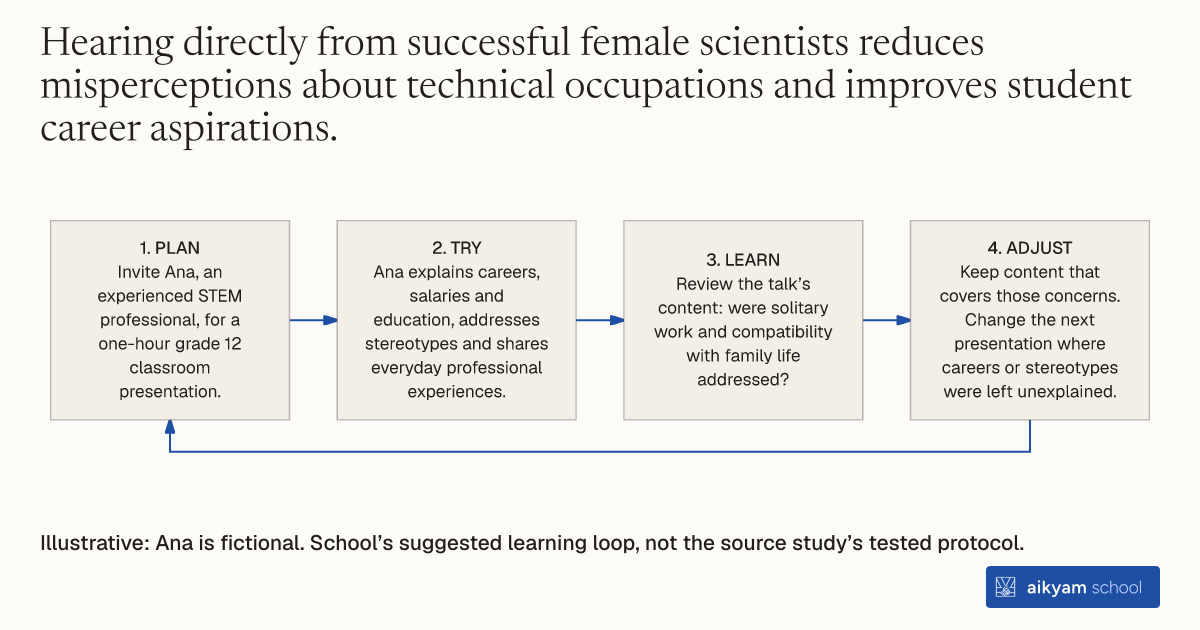
- Plan: Invite Ana, an experienced STEM professional, for a one-hour grade 12 classroom presentation.
- Try: Ana explains careers, salaries and education, addresses stereotypes and shares everyday professional experiences.
- Learn: Review the talk’s content: were solitary work and compatibility with family life addressed?
- Adjust: Keep content that covers those concerns. Change the next presentation where careers or stereotypes were left unexplained.
Illustrative: Ana is fictional. School’s suggested learning loop, not the source study’s tested protocol.
See source →School’s suggested, untested loop. Observe the content of the talk; do not infer a change in enrolment.
How
When to use
Women remain underrepresented in STEM careers due to restrictive social stereotypes and a lack of female role models. This gap reduces economic opportunities for women in high-paying technical fields. Send experienced female scientists to give short classroom presentations to high school students.
Arrange classroom visits by professional women scientists to inspire high school students and dismantle career stereotypes.
- Recruit experienced female professionals working in STEM fields rather than young researchers.
- Schedule a one-hour in-class presentation for grade 12 classrooms during normal school hours.
- Present clear factual information regarding science-related career paths, expected salaries, and required educational paths.
- Discuss common stereotypes directly, including the belief that scientific careers are solitary or incompatible with family life.
- Share personal career journeys and everyday professional experiences with the class.
Why it works
It provides reassurance regarding family compatibility and motivates female students toward male-dominated subjects.
Example
In French high schools, female scientists gave one-hour classroom presentations to grade 12 students. The intervention increased the likelihood of female students enrolling in male-dominated STEM programs by 3.4 percentage points, raising enrollment from 17 percent to 20.4 percent.
About the study
Participants
Grade 12 high school students in France.
Study Design
Randomized controlled trial evaluating classroom visits by female scientists versus a control group.
Results
Enrolling in male-dominated STEM programs increased by 3.4 percentage points, rising from 17 percent to 20.4 percent (a 20 percent relative increase).