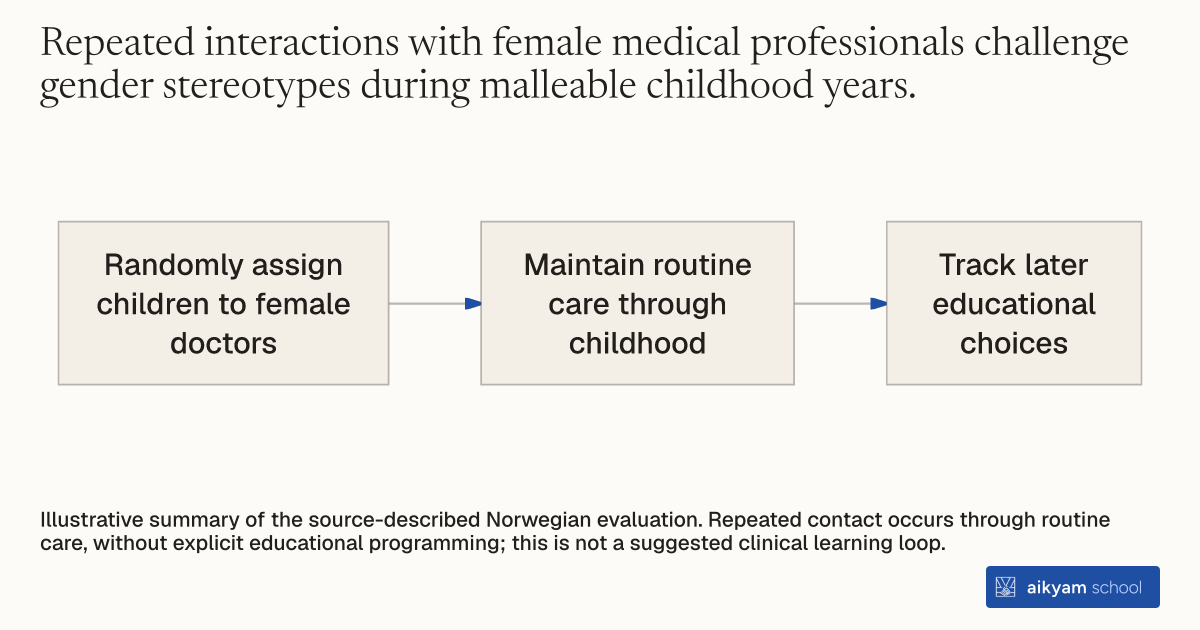
Research steps
Describe childhood contact with a female doctor
- Randomly assign children to female doctors
- Maintain routine care through childhood
- Track later educational choices
Illustrative summary of the source-described Norwegian evaluation. Repeated contact occurs through routine care, without explicit educational programming; this is not a suggested clinical learning loop.
See source →How
When to use
Girls often lack exposure to professional women working in scientific and medical fields during childhood. This lack of same-gender role models reinforces career stereotypes and reduces interest in technical tracks. Assign girls to female general practitioners during childhood to provide repeated contact with female medical professionals.
Assign female primary care doctors to young girls through general practitioner healthcare systems.
- Match children randomly to female primary care physicians in public healthcare systems.
- Provide routine childhood medical checkups and primary care consultations with the assigned female doctor.
- Maintain continuous care assignments across childhood years to foster repeated natural interactions.
- Allow same-gender professional contact to normalize women in technical and scientific careers without explicit educational programming.
Why it works
Same-gender doctors enable high-ability girls, especially from lower-income backgrounds, to recognize their own scientific potential.
Example
In Norway, researchers evaluated children randomly assigned to female primary care doctors. Girls assigned to a female medical doctor during childhood were 4 percentage points more likely to choose a STEMM program in high school.
About the study
Participants
Children in Norway receiving general practitioner healthcare assignments during childhood.
Study Design
Randomized assignment evaluation of primary care doctor gender on long-term student educational choices.
Results
Girls with a female childhood doctor were 4 percentage points (20 percent) more likely to choose a STEMM program in high school, with effects persisting into college and driven by high-ability girls from less-advantaged socioeconomic backgrounds; no effect was found for boys.