Try, learn and adjust
Check farm training follows the seasonal sequence
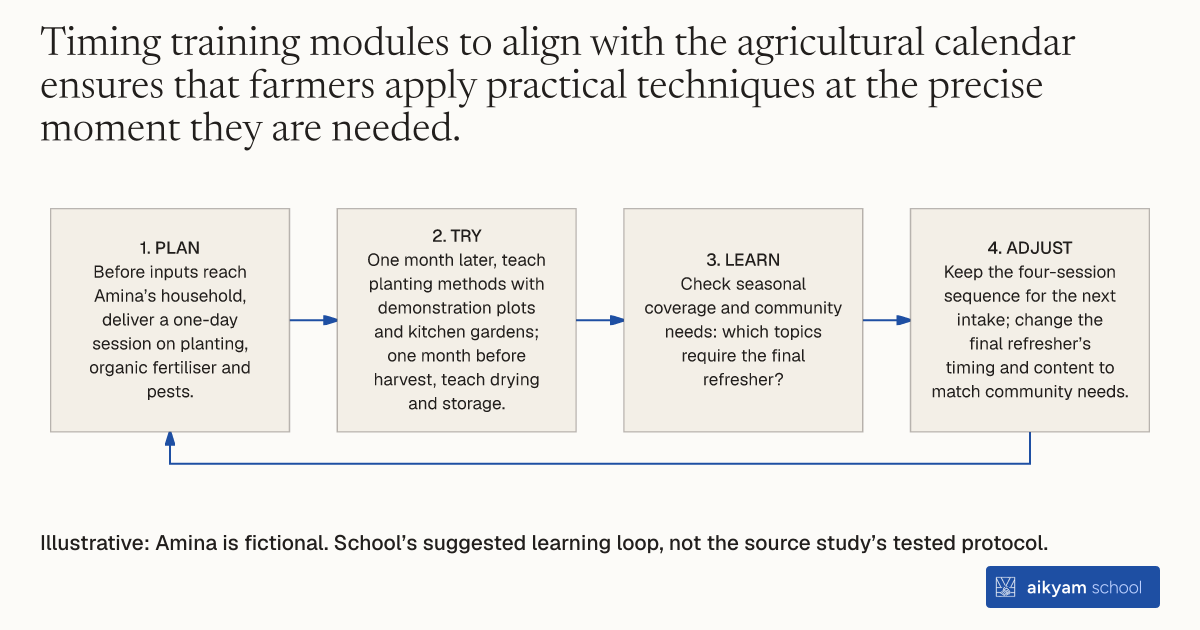
- Plan: Before inputs reach Amina’s household, deliver a one-day session on planting, organic fertiliser and pests.
- Try: One month later, teach planting methods with demonstration plots and kitchen gardens; one month before harvest, teach drying and storage.
- Learn: Check seasonal coverage and community needs: which topics require the final refresher?
- Adjust: Keep the four-session sequence for the next intake; change the final refresher’s timing and content to match community needs.
Illustrative: Amina is fictional. School’s suggested learning loop, not the source study’s tested protocol.
See source →School’s suggested, untested learning loop. Observe training before inputs, planting guidance, pre-harvest training and the final refresher; no crop-sales effect is assumed.
How
When to use
Smallholder farmers in low-income rural communities often experience low agricultural productivity due to outdated farming techniques and improper post-harvest handling. Providing structured, seasonally timed group training paired with practical demonstration plots helps rural households adopt modern agronomic practices. This approach is intended for farming communities where all adult residents participate in subsistence and commercial crop production.
Deliver a four-part seasonal agricultural training sequence supported by village demonstration plots and kitchen garden instruction to improve household crop yields.
- Conduct the first one-day training before input distribution, focusing on planting techniques, organic fertilizer preparation, and pest management.
- Hold the second one-day training one month later to instruct farmers on optimal planting methods, including line spacing.
- Establish demonstration plots within the village to showcase best growing practices and teach households how to plant kitchen gardens for vegetable consumption.
- Deliver the third one-day training one month before harvest, covering post-harvest management, crop drying, and the use of PICS storage bags.
- Provide a final refresher training session at a time determined by specific community needs.
Why it works
Combining classroom instruction with village demonstration plots reinforces learning and drives high adoption of best practices across the entire community.
Example
In rural western Uganda, Raising the Village delivered four one-day agricultural training sessions and set up village demonstration plots for all households, increasing crop yields and raising monthly farm sales by USD 21.46 PPP.
About the study
Participants
3,852 households across 335 villages in Kagadi and Kyenjojo districts, western Uganda, where 35% of households fall below the \$2.15 PPP daily poverty line post-harvest and 65% during the lean season.
Study Design
Clustered randomized controlled trial across 114 village clusters covering 335 villages, comparing a universal livelihoods program to a pure control group.
Results
Monthly crop sales increased by 27% (USD 21.46 PPP, p < 0.01), fertilizer use increased by 16.55 kg in Season 1 and 9.10 kg in Season 2, and land area planted expanded by 0.16 acres in Season 1 and 0.19 acres in Season 2.