Try, learn and adjust
Check annual goals remain accessible
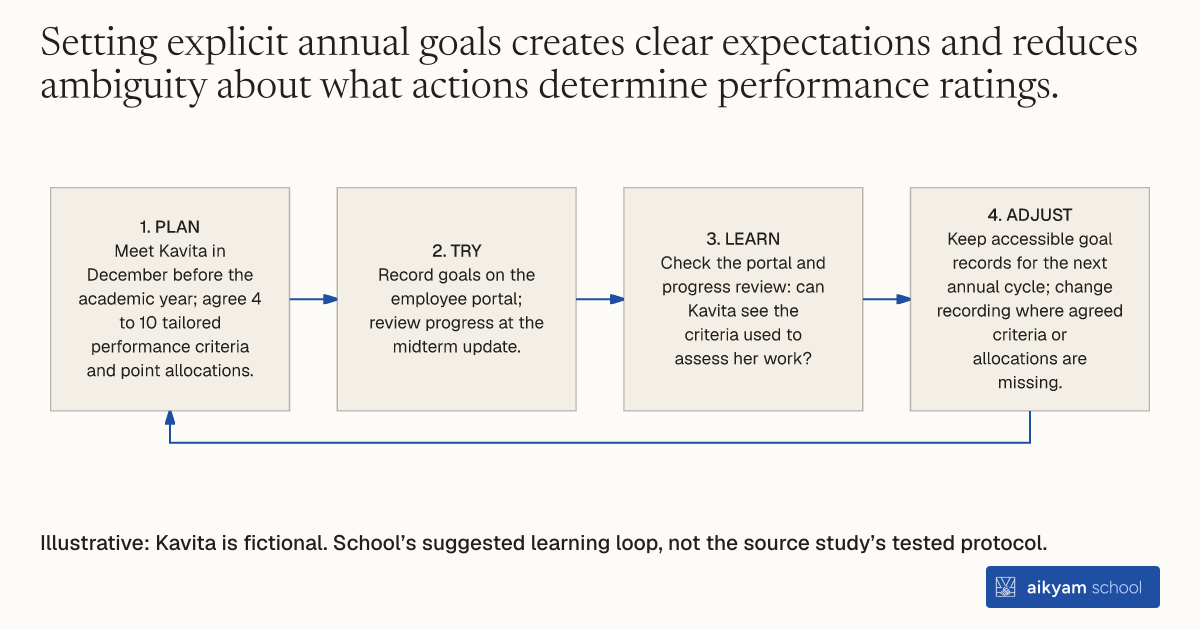
- Plan: Meet Kavita in December before the academic year; agree 4 to 10 tailored performance criteria and point allocations.
- Try: Record goals on the employee portal; review progress at the midterm update.
- Learn: Check the portal and progress review: can Kavita see the criteria used to assess her work?
- Adjust: Keep accessible goal records for the next annual cycle; change recording where agreed criteria or allocations are missing.
Illustrative: Kavita is fictional. School’s suggested learning loop, not the source study’s tested protocol.
See source →School’s suggested, untested learning loop. Observe recorded criteria, point allocations and midterm progress; the loop does not establish student outcomes.
How
When to use
School managers and employers face uncertainty when evaluating staff without predefined performance standards. Unstructured evaluation leads to misaligned employee effort, ambiguous expectations, and perceived unfairness. Establishing explicit, tailored annual performance criteria allows managers to clarify organizational priorities for teachers before work begins.
Delineate specific annual performance criteria in one-on-one planning meetings between school managers and teachers prior to the start of the school year.
- Convene an annual planning session between the school principal or vice-principal and each core teacher in December before the academic year begins.
- Formulate 4 to 10 specific performance criteria tailored to each teacher, covering areas such as student behavioral management, pedagogy, professional development, and administrative support.
- Record the agreed-upon criteria and point allocations on the employee online portal so teachers can access their targets throughout the year.
- Categorize criteria into actionable target areas including student understanding assessment, differentiated lesson planning, curriculum delivery, and classroom environment support.
- Review teacher progress against these recorded criteria during midterm information updates halfway through the twelve-month appraisal period.
Why it works
Aligning manager priorities with professional development and test targets directs employee effort toward productive outcomes without increasing perceived contract noise.
Example
School managers across private schools in Pakistan sat down with 6,080 teachers in December to establish 4 to 10 individual performance goals recorded on employment dashboards. When managers prioritized professional development goals alongside test targets under subjective contracts, student test scores increased by 0.250 standard deviations.
About the study
Participants
6,080 teachers (80% female), 189 managers, and 440,595 student test observations across private schools in Pakistan (grades 4–13).
Study Design
Randomized controlled trial (RCT) analyzing text-coded manager goal categories (administrative, professional development, pedagogy, test-prep) interacted with performance raise contracts across 255 school clusters.
Results
Setting goals focused on professional development and test preparation increased student test scores by 0.250 standard deviations (p < 0.05) and 0.189 standard deviations (p < 0.05) respectively under subjective contracts, while test-prep goals decreased student socio-emotional scores by 0.162 standard deviations (p < 0.10).