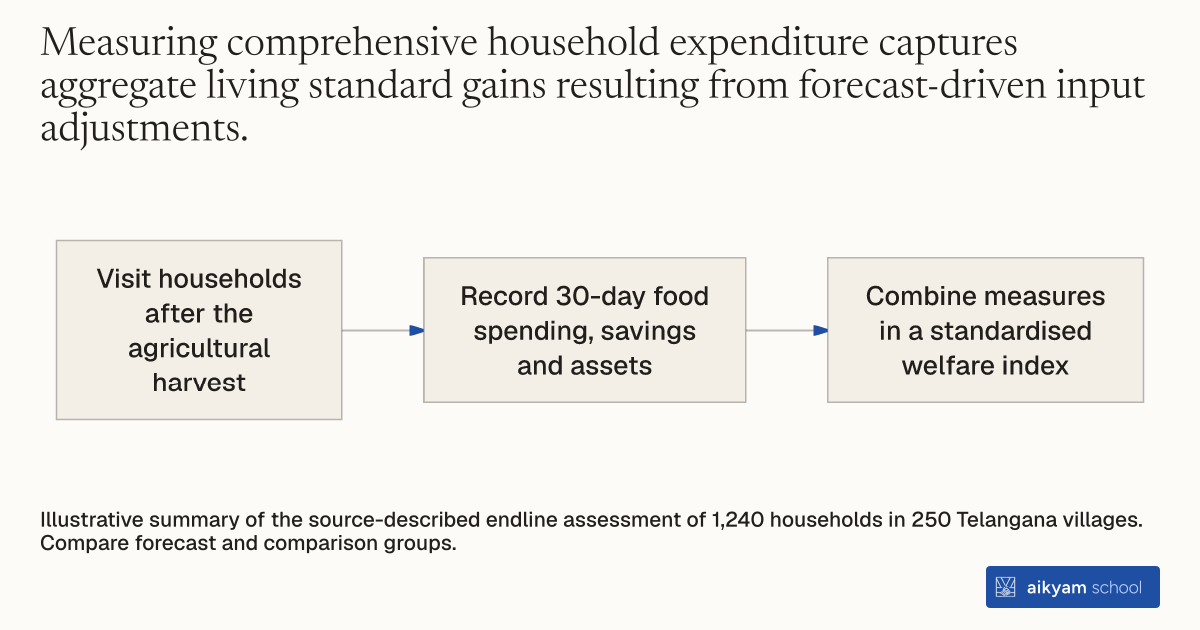
Research steps
Measure household welfare after harvest
- Visit households after the agricultural harvest
- Record 30-day food spending, savings and assets
- Combine measures in a standardised welfare index
Illustrative summary of the source-described endline assessment of 1,240 households in 250 Telangana villages. Compare forecast and comparison groups.
See source →How
When to use
Agricultural households face weather risks that threaten living standards and food security. Measuring crop outputs alone fails to capture broader improvements in family living conditions. Conducting detailed endline welfare surveys quantifies overall gains in food consumption, net savings, and asset accumulation.
Assess total household welfare and food consumption changes following agricultural forecast interventions.
- Visit farming households after harvest completion at the end of the agricultural season.
- Collect detailed consumption expenditures for food items over a prior 30-day reference period.
- Record changes in household net savings and durable asset values.
- Construct a standardized welfare index combining consumption, savings, and asset metrics across treatment and comparison groups.
Why it works
Combining consumption, savings, and asset metrics isolates overall welfare improvements from seasonal income fluctuations.
Example
Researchers surveyed 1,240 households across 250 villages in Telangana, India, after the harvest. Access to seasonal weather forecasts improved household welfare by 0.06 standard deviations and raised 30-day per-capita food consumption by 7 percent, equivalent to US\$13.22 per household.
About the study
Participants
1,240 farming households across 250 villages in Telangana, India.
Study Design
Endline household survey administration during a Randomized Controlled Trial (RCT) evaluating seasonal weather forecasts relative to comparison groups.
Results
Forecast access increased overall household welfare by 0.06 SD and increased per-capita food consumption by 7 percent (US\$13.22 over the prior 30 days) relative to comparison households.