In Simple Words
Imagine giving a family a new budgeting app and a specialized insurance card. While they might reorganize their debt or buy the card, their total overall household income, food on the table, and daily stress levels remain unchanged because these larger life outcomes are driven by fundamental economic factors rather than basic financial tweaks.
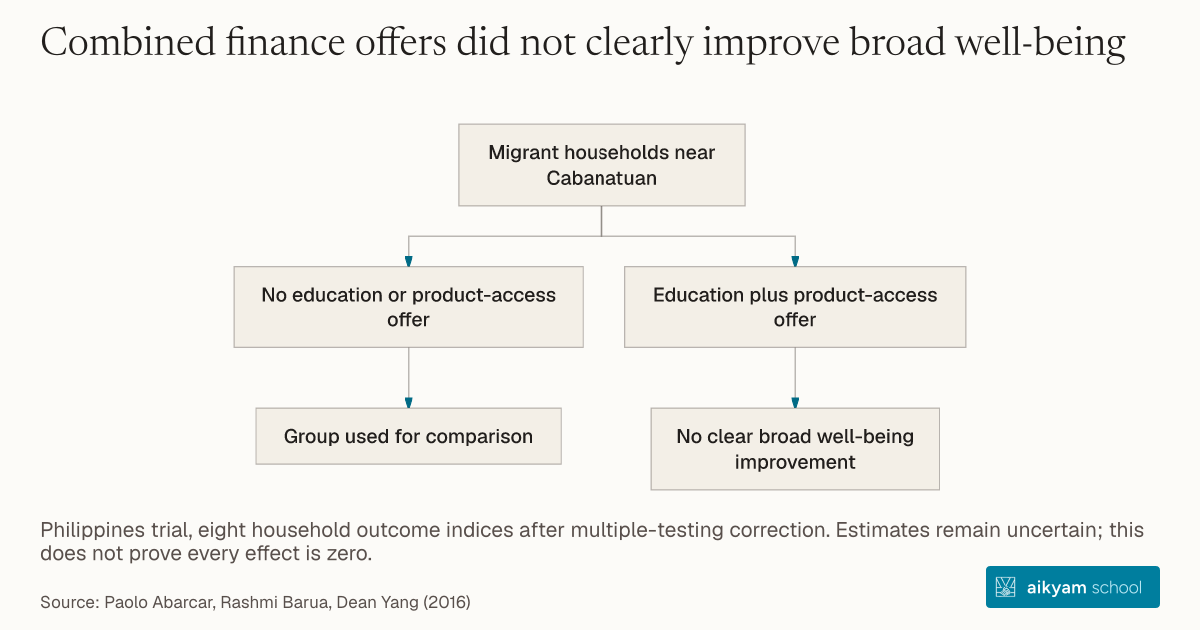
Migrant households near Cabanatuan
- No education or product-access offer
- Group used for comparison
- Education plus product-access offer
- No clear broad well-being improvement
Philippines trial, eight household outcome indices after multiple-testing correction. Estimates remain uncertain; this does not prove every effect is zero.
See source →Research question
Evaluations of financial inclusion and education programs often measure localized behavioral shifts, but fail to establish whether these changes translate into broader improvements in overall household well-being and life satisfaction.
Participants
N = 1,558 transnational households surveyed at endline in Cabanatuan City and surrounding localities, Philippines.
Study Design
Four-arm randomized controlled trial evaluating composite z-score indices across 8 categories (Life Satisfaction, Income, Migrant/Remittances, Consumption/Expenditure, Goals, Savings, Borrowing/Lending, Financial Literacy) with Benjamini-Hochberg false discovery rate (FDR) q-value corrections.
Results
No statistically significant impacts were detected across any of the 8 categorical welfare indices (all q-values ≥ 0.240), and the combined intervention showed no differential effect compared to individual treatments (p-value for T1+T2=T3 ranged from 0.268 to 0.969).
Takeaway
Apply multiple-inference corrections (such as Benjamini-Hochberg q-values) when evaluating broad multi-outcome household welfare impacts to prevent false positives in program evaluations.
Source and citation
See source →Read alongside the research
Plain-English glossary
Original explanations, informed by the references below. Examples are illustrations, not data from the studies above. The research text stays unchanged.
- Randomized controlled trial
A study that uses chance, like drawing lots, to decide who receives each option being compared. Researchers compare the groups’ outcomes to estimate the effect of those options.
ExampleA lottery assigns volunteers to a training programme or a comparison group. Researchers then compare their outcomes.
GET-IT glossary · Randomized study ↗Read more about randomized controlled trial →- Statistically significant
A label used when a result passes a chosen statistical threshold, often p < 0.05. It does not show how large or useful an effect is. A result that is not statistically significant does not prove there is no effect.
ExampleA study reports p = 0.03 against a 0.05 threshold. It passes that test, but the effect could still be too small to matter.
American Statistical Association · Statement on p-values ↗Read more about statistically significant →