Research procedure
Follow households after title delivery
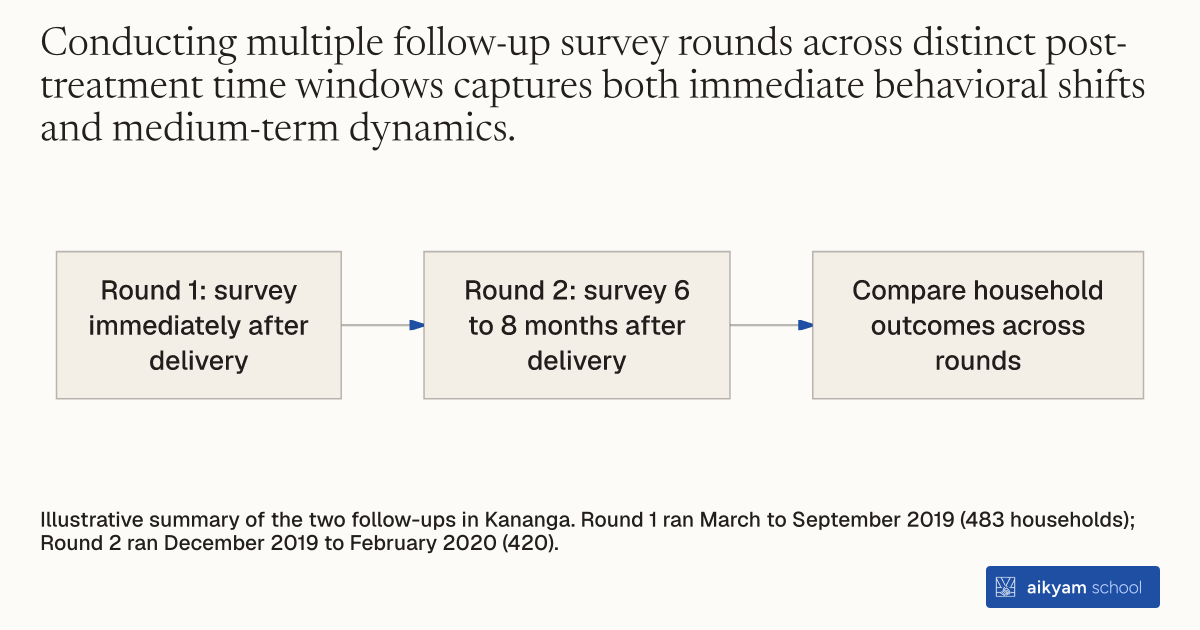
- Round 1: survey immediately after delivery
- Round 2: survey 6 to 8 months after delivery
- Compare household outcomes across rounds
Illustrative summary of the two follow-ups in Kananga. Round 1 ran March to September 2019 (483 households); Round 2 ran December 2019 to February 2020 (420).
See source →How
When to use
In field experiments evaluating legal or social interventions, immediate post-treatment surveys may fail to capture delayed behavioral adjustments or fading program effects over time. Program evaluators need a reliable method to track participant outcomes across multiple post-intervention time horizons. Administering multi-round longitudinal endline surveys allows researchers to measure both immediate and medium-term impacts on household choices, social participation, and views of local authorities.
Track post-intervention household outcomes by administering structured multi-round longitudinal follow-up surveys across multiple post-treatment time horizons.
- Schedule a first endline survey round (Round 1) to occur immediately following the delivery of intervention benefits as described in Section 5.
- Schedule a second endline survey round (Round 2) to take place roughly 6 to 8 months after initial benefit delivery.
- Deploy enumerators to re-interview baseline sample respondents at their compounds across both survey rounds.
- Measure primary behavioral outcomes, including tax compliance, engagement with informal social networks, and evaluations of local leaders as detailed in Section 5.
- Compare outcome indicators across survey rounds to evaluate the persistence and dynamics of treatment effects over time.
Why it works
This prevents researchers from mistaking short-term adjustments for permanent institutional changes.
Example
Researchers conducted two longitudinal endline survey rounds in Kananga, DRC—Round 1 from March to September 2019 and Round 2 from December 2019 to February 2020—re-interviewing baseline respondents 6 to 8 months after land title delivery.
About the study
Participants
4,343 randomly sampled baseline households in Kananga, Democratic Republic of Congo, with 483 eligible households tracked across Round 1 (N = 483) and Round 2 (N = 420).
Study Design
Multi-round longitudinal follow-up survey administered in two rounds (Round 1 immediately post-delivery, Round 2 6–8 months post-delivery) to evaluate a randomized land titling trial.
Results
Program assignment caused a 0.203 standard deviation decrease in social institution participation in Round 1 and a 0.163 standard deviation decrease in Round 2, alongside a 0.312 standard deviation decrease in favorable views of chiefs.