Try, learn and adjust
Check the purchased asset secures the loan
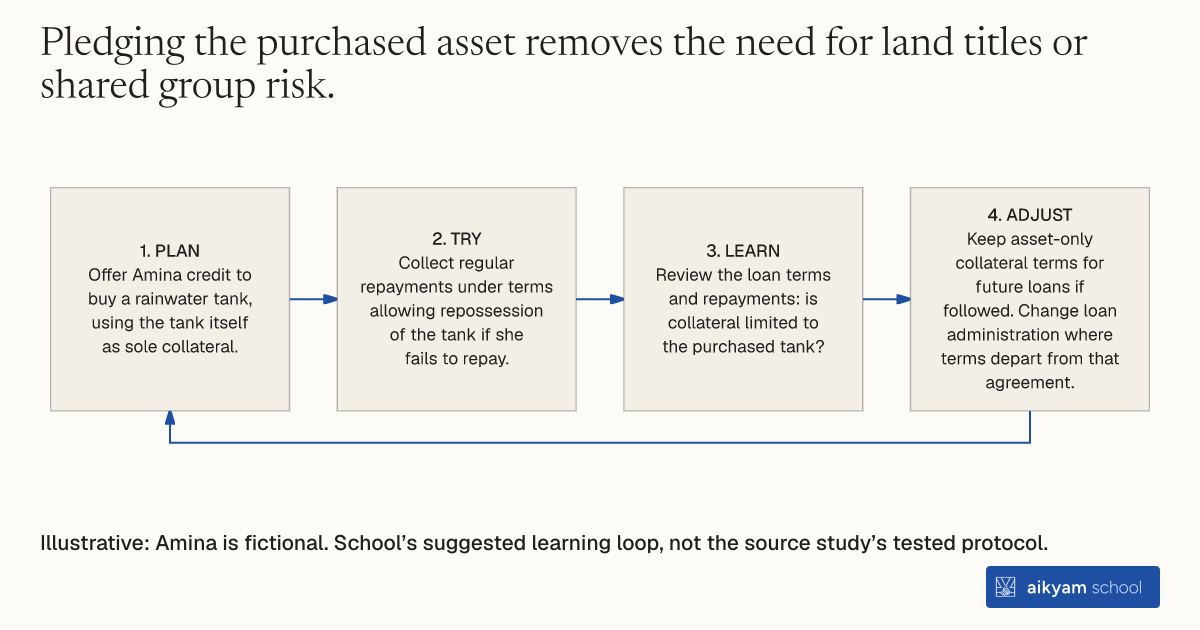
- Plan: Offer Amina credit to buy a rainwater tank, using the tank itself as sole collateral.
- Try: Collect regular repayments under terms allowing repossession of the tank if she fails to repay.
- Learn: Review the loan terms and repayments: is collateral limited to the purchased tank?
- Adjust: Keep asset-only collateral terms for future loans if followed. Change loan administration where terms depart from that agreement.
Illustrative: Amina is fictional. School’s suggested learning loop, not the source study’s tested protocol.
See source →School’s suggested, untested loop. Observe collateral terms, repayments and defaults. This is credit with repossession risk, not a grant.
How
When to use
Smallholder farmers lack land titles to meet formal bank collateral requirements. Joint liability loans force farmers to guarantee neighbors who face identical drought or price shocks. Asset-collateralized loans allow farmers to secure debt using the specific capital asset being purchased.
Secure agricultural loans using the purchased physical asset as collateral rather than land titles or group guarantees.
- Financial institutions offer loans to farmers specifically for purchasing physical productive assets.
- Lenders allow the purchased asset itself to serve as sole loan collateral.
- Borrowers make regular repayments to finance the asset purchase.
- Lenders repossess the specific asset if the borrower fails to repay the loan.
Why it works
Farmers access credit without risking land or relying on neighbors facing the same weather shocks.
Example
A dairy cooperative in Kenya offered farmers credit to purchase rainwater collection tanks for cattle drinking water. Lenders secured loans by reserving the right to repossess tanks if farmers failed to repay. Under these terms, 44 percent of farmers borrowed compared to 2.4 percent under group guarantee loans, with no increase in default rates.
About the study
Participants
Dairy farmers in Kenya.
Study Design
Randomized controlled trial comparing asset-collateralized loans for rainwater tanks against traditional group-guaranteed loans.
Results
Loan take-up increased from 2.4 percent under group liability to 44 percent under asset collateralization, without increasing default rates.