Research steps
Assign participants within platform blocks
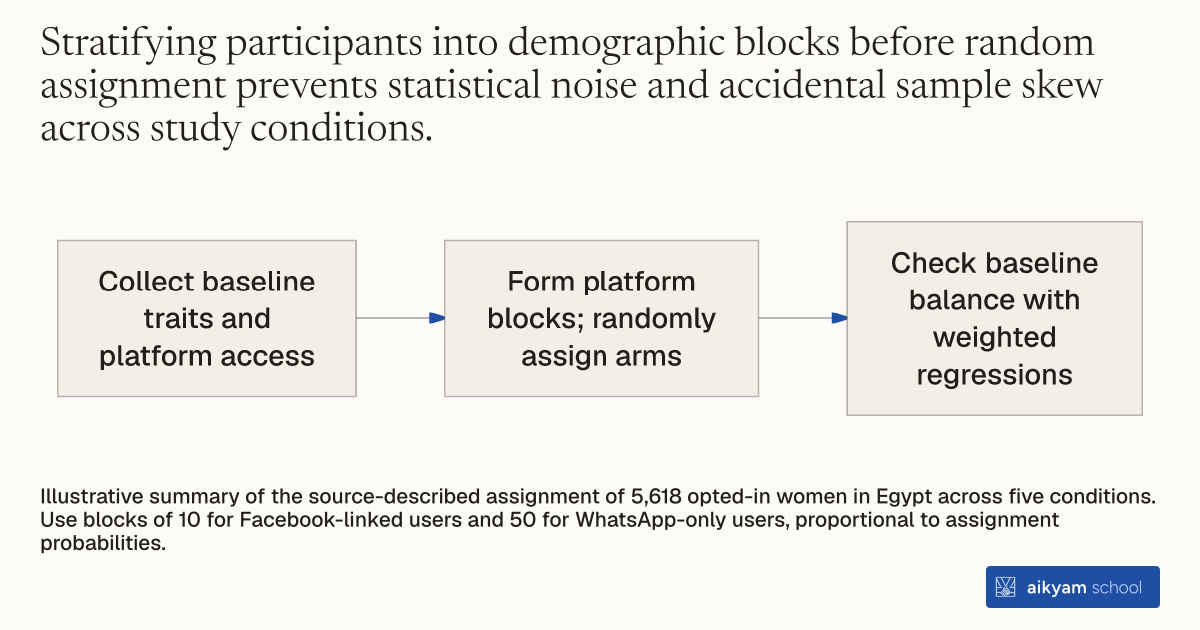
- Collect baseline traits and platform access
- Form platform blocks; randomly assign arms
- Check baseline balance with weighted regressions
Illustrative summary of the source-described assignment of 5,618 opted-in women in Egypt across five conditions. Use blocks of 10 for Facebook-linked users and 50 for WhatsApp-only users, proportional to assignment probabilities.
See source →How
When to use
When evaluating multi-arm interventions, simple random assignment can create accidental imbalances in key baseline characteristics across conditions. Implementing demographic block randomization ensures equal distribution of participant background traits across treatment and control groups. This method helps researchers maintain experimental balance across study arms in field trials.
Assign opted-in study participants to treatment conditions using demographic block randomization to maintain balance across experimental groups.
- Collect baseline survey data on participant demographics, contact platform availability, and initial attitudes.
- Form distinct randomization blocks based on participant platform access, such as whether a Facebook account is linked or only WhatsApp is available.
- Set block sizes proportional to treatment probability ratios, using blocks of 10 for users with Facebook accounts and blocks of 50 for WhatsApp-only users.
- Randomly assign participants within each block across the control and treatment arms.
- Verify covariate balance across assigned treatment arms using weighted least squares balance regressions.
Why it works
Block randomization ensures that baseline characteristics like age, education, and platform access are evenly distributed across all treatment groups.
Example
In Egypt, researchers block-randomized 5,618 opted-in women across five treatment conditions based on whether they provided a Facebook account (blocks of 10) or only WhatsApp details (blocks of 50), achieving complete covariate balance across all baseline demographic variables.
About the study
Participants
5,618 female internet users in Egypt assigned across treatment arms using baseline demographic block randomization.
Study Design
Randomized field experiment using block randomization stratified by platform availability (Facebook account vs WhatsApp only) across five experimental conditions.
Results
Block randomization achieved full baseline covariate balance across 35 baseline demographic and attitudinal variables across experimental arms.