Research steps
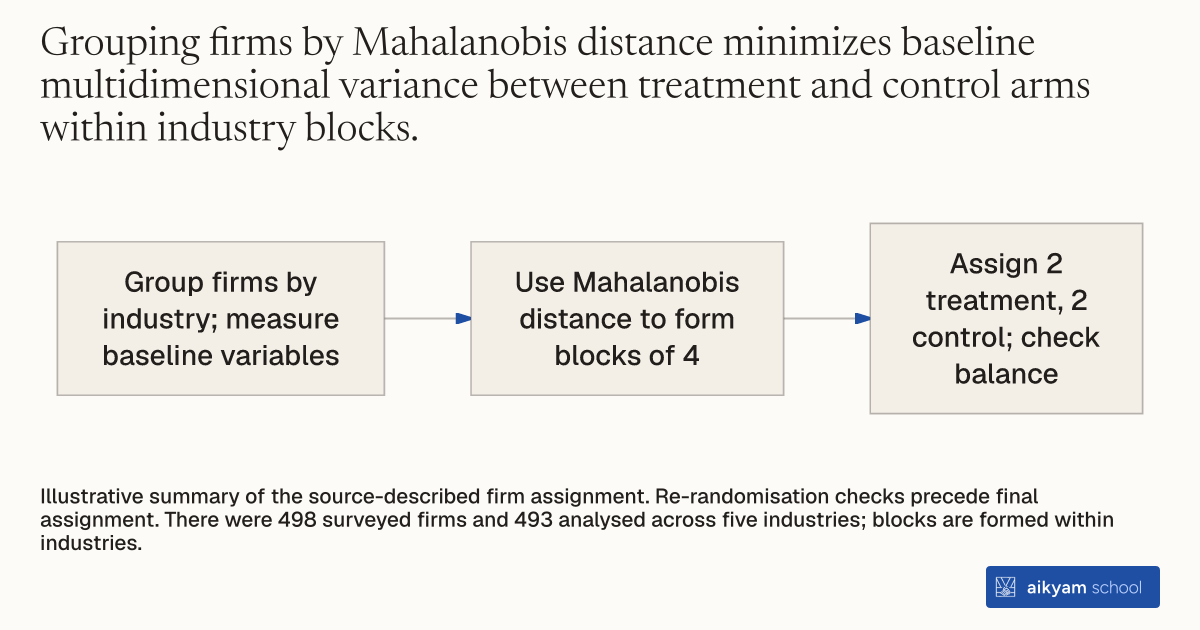
Randomise firms within matched blocks
- Group firms by industry; measure baseline variables
- Use Mahalanobis distance to form blocks of 4
- Assign 2 treatment, 2 control; check balance
Illustrative summary of the source-described firm assignment. Re-randomisation checks precede final assignment. There were 498 surveyed firms and 493 analysed across five industries; blocks are formed within industries.
See source →How
When to use
Use this method when assigning small employer samples to experimental treatment and control groups in field experiments. It solves the problem of baseline sample imbalance and statistical power loss in small-N RCTs. It serves experimental economists, trialists, and program evaluators designing firm-level interventions.
Randomize firm treatment status by partitioning similar companies into statistical blocks using multidimensional distance metrics.
- Group surveyed firms into distinct primary industry classifications.
- Select key baseline firm covariates including employee count, turnover, salary, workforce composition, and geographical distance to the city center.
- Calculate pairwise Mahalanobis distances across baseline variables for all firms within each industry sector.
- Form clusters of four nearest-neighbor firms based on calculated Mahalanobis distances within each industry.
- Randomly assign two firms within each four-firm cluster to the treatment group and the remaining two firms to the control group.
- Run re-randomization procedures to check balance across baseline covariates and confirm statistical power before final assignment.
Why it works
Re-randomization prevents accidental covariate imbalances that frequently occur in small experimental sample sizes.
Example
Researchers in Addis Ababa, Ethiopia partitioned 498 surveyed formal employers into five industry sectors. They formed nearest-neighbor blocks of four firms using Mahalanobis distance over baseline workforce and salary variables, successfully achieving statistical balance across all treatment arms.
About the study
Participants
N = 498 formal sector firms (493 analyzed) across five main industries in Addis Ababa, Ethiopia.
Study Design
Block-randomized trial partitioning firms into four-firm nearest-neighbor clusters based on Mahalanobis distance with re-randomization balance checks.
Results
Achieved statistically complete balance across all baseline firm covariates with covariate balance test p-values ranging from 0.150 to 0.963 across all specifications.